

What It Takes To Be Found in Local Search
For years, Google Business Profile had a fairly straightforward job. It helped customers find your business on Google Search and Maps, see your hours, read your reviews, get directions, call you, and visit your website.
Those things still matter, but Google Business Profile is becoming part of something bigger.
Google has been steadily adding AI across its search products. Features like AI Overviews can summarize information from multiple sources and give users a direct response within the search results.
Now, Google is bringing that same kind of AI experience more directly into local search with a newer feature called Ask Maps.
Ask Maps lets people ask detailed questions about nearby businesses and places using everyday language. A customer might ask which business is open now, who offers a specific service, or which option is a better fit for what they need.
Google can build those answers using information connected to local businesses, including hours, services, reviews, photos, website content, and other details it has collected.
For business owners, this adds a new layer to Google Business Profile. Your profile is not only helping people find your business; it can also help Google understand when your business is relevant to a specific local question.
That raises an important question: Does Google have enough accurate information to understand your business and know when it should appear in those answers?
The Set-It-and-Forget-It Google Business Is Fading
A strong Google Business Profile has always depended on accurate information. Today, that information is playing a bigger role in how Google understands a business and connects it with local searches.
Your category, location, hours, reviews, phone number, services, and website still matter. In fact, many of those fundamentals remain among the strongest signals in local search.
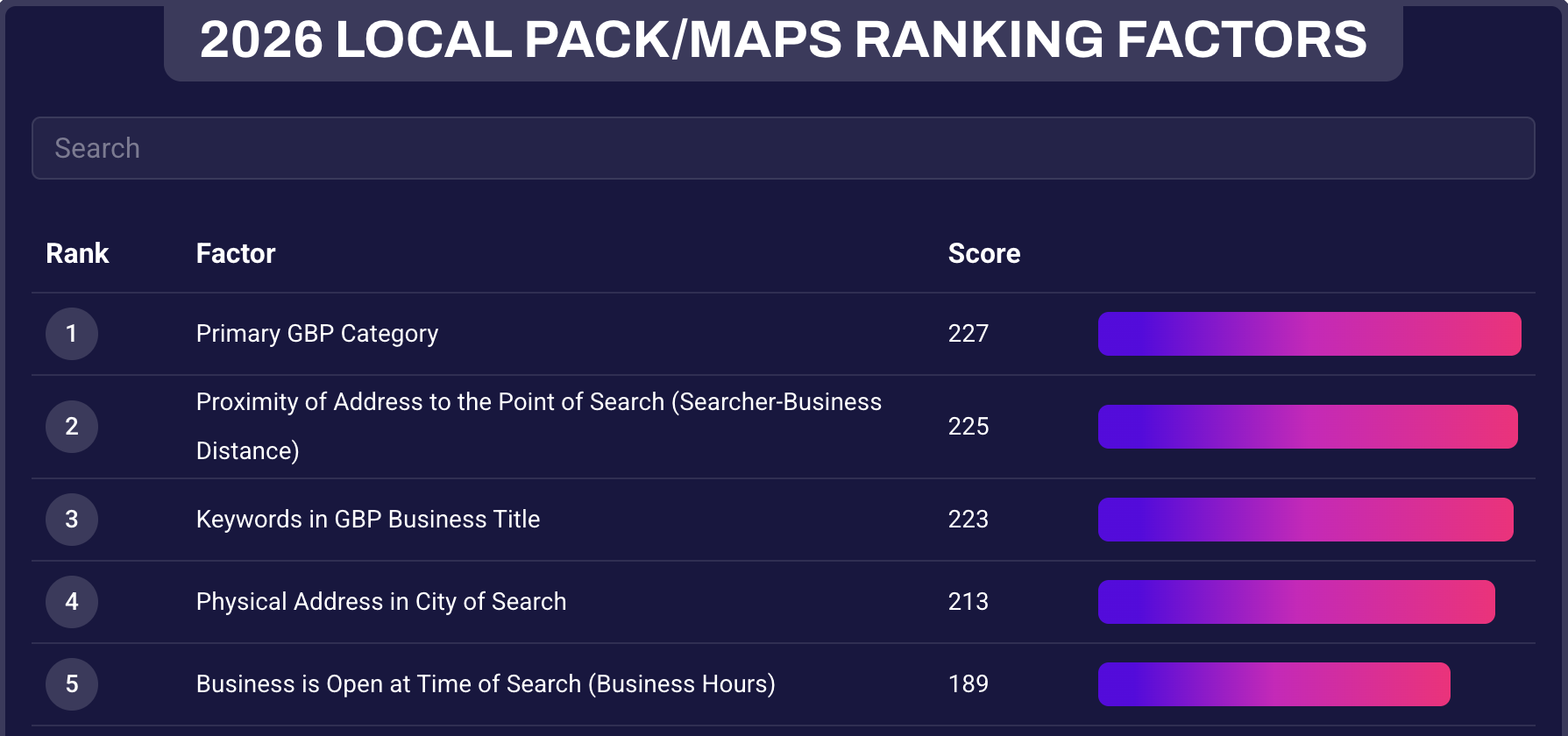
Whitespark’s 2026 Local Search Ranking Factors report surveyed 47 local search experts across 187 factors. The top factors for Google Maps and the local pack included the primary Google Business Profile category, proximity to the searcher, the business name, having a physical address in the city being searched, whether the business is open at the time of the search, and Google review ratings.
So the fundamentals have not gone away. What is changing is the idea that a business can fill out its profile once, leave it untouched for months, and consider the job finished.
A Google Business Profile should reflect the business as it operates today, with current information about services, hours, reviews, photos, and other details customers may rely on.
As Google uses that information to answer more specific local questions, outdated or incomplete profiles can create a weaker picture of the business and make it harder for Google to understand when that business is relevant.
Being Current Does Not Mean Posting Every Day
There is an important distinction here.
A more active Google Business Profile does not mean businesses need to turn GBP into another social media account that requires constant posting.
The 2026 Whitespark research still places the core business information much higher than factors such as the frequency or quantity of Google Posts.
Therefore, the priority should be accuracy, completeness, and relevance.
That means making sure:
Your primary and additional categories accurately describe the business
Your regular and special hours stay current
Your services reflect what you actually offer
Your phone number, address, and website are correct
Customers continue leaving recent reviews
New photos show current work, products, staff, or locations
Booking, appointment, menu, or other available links work properly
One of the more notable changes in Whitespark’s 2026 survey is the importance of business hours. Being open at the time of the search ranked fifth among local pack and Maps factors.
Something as simple as forgetting to update holiday hours can now affect more than the information displayed on the profile. It can influence whether a business is a useful result for someone searching at that moment.
A useful way to think about your Google Business Profile is as a living record of your business. When something meaningful changes, the profile should reflect it.
Google Is Looking Beyond What You Enter Into Your Profile
Google Business Profile is not a closed database where Google only knows what the business owner types into the fields.
Google says Business Profile information can come from several sources, including the business itself, publicly available information on the web, the business’s website, licensed third-party data, customer contributions, photos, reviews, and Google's own interactions with a place.
That gives businesses a larger job than maintaining one listing.
Google needs to see a clear picture of the business across the web. If your Business Profile says one thing, your website says something different, and major directories contain old information, that picture becomes harder to interpret.
The same applies to services.
A contractor may list “commercial concrete” in Google Business Profile. A stronger signal exists when the company also has a clear commercial concrete page on its website, customers mention that work in reviews, and reputable industry or local websites associate the company with that service.
And this becomes especially relevant when AI is involved.
Whitespark added an AI Search Visibility category to its study for the first time in its 2026 report. The factors local search experts rated highest included:
Appearing on credible “best of” and expert-curated lists
Having a dedicated website page for each service
Being mentioned on important industry websites
Mentions from authoritative sources such as news sites, government websites, blogs, and industry associations
Reviews appearing on authoritative third-party websites
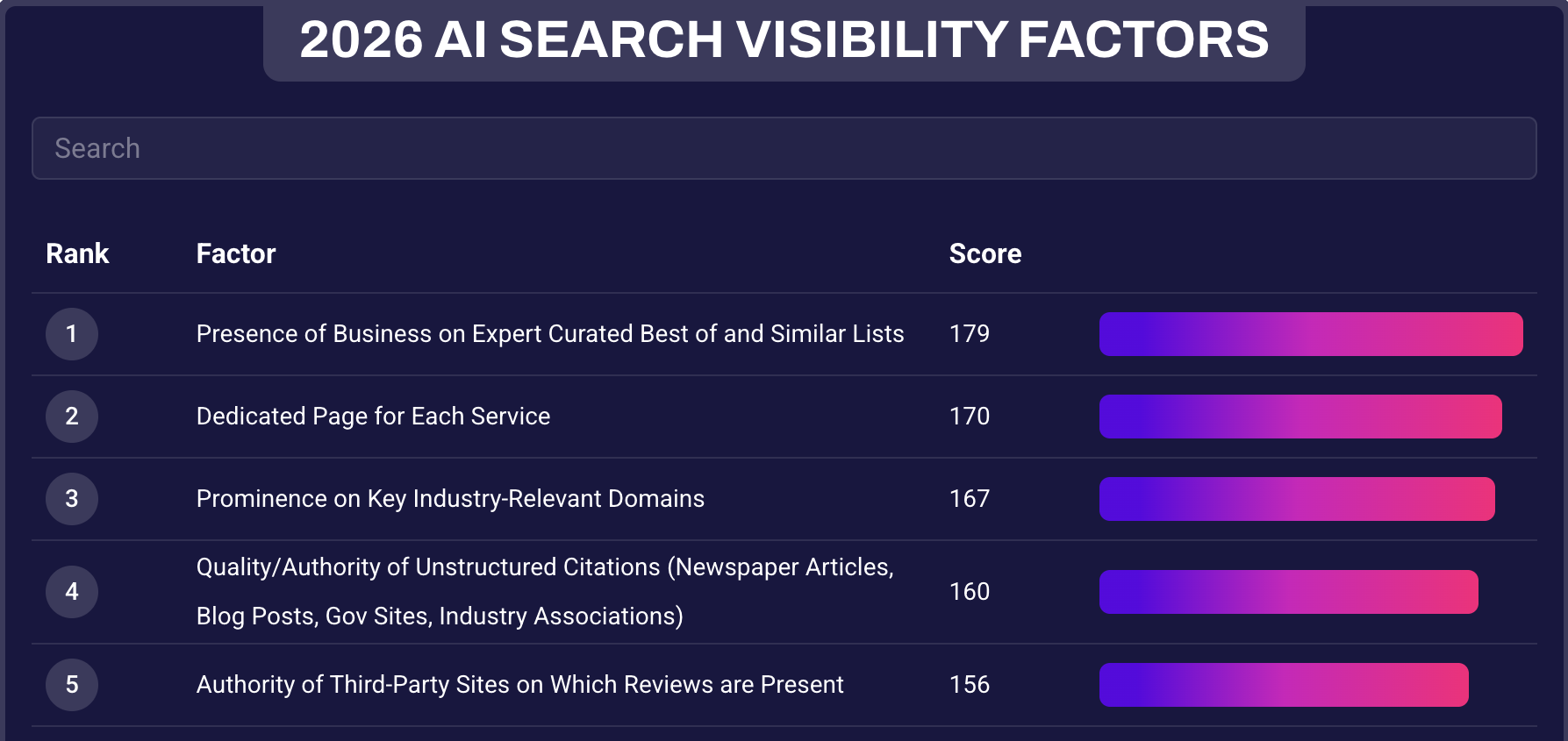
Notice that most of those signals live outside Google Business Profile.
That is an important part of preparing for AI-driven local search. Your profile gives Google important information about your business, while your website, reviews, directories, and outside mentions help support and expand that information.
Ask Maps Shows Where Local Search Is Heading
Google officially introduced Ask Maps in March 2026, giving us a clearer look at how AI could reshape local search.
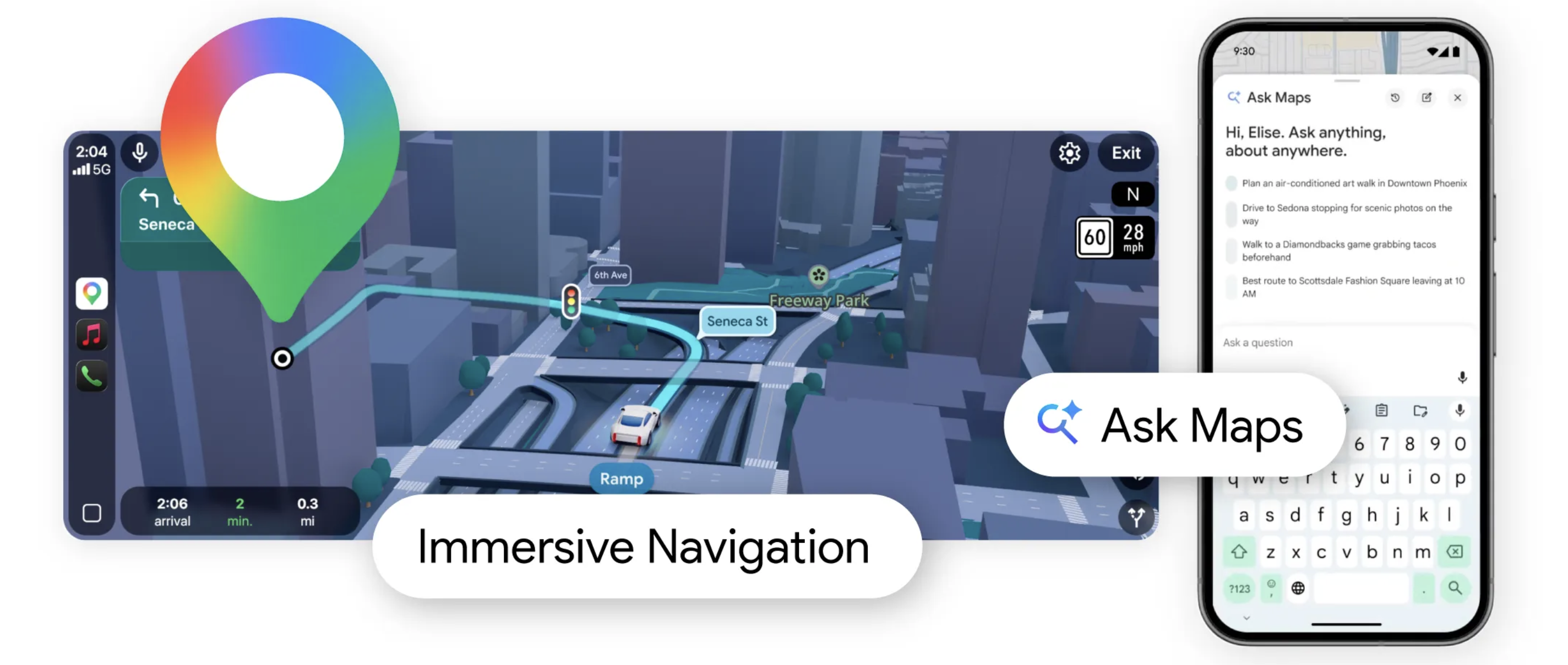
Powered by Gemini, Ask Maps can consider multiple pieces of information about businesses and places when responding to a user's question. Google says the system can draw from information about more than 300 million places and reviews contributed by a community of more than 500 million people. That can include information tied to a business, such as its hours, services, reviews, photos, website content, and other details Google has gathered from across the web.
The feature lets people ask detailed questions about nearby businesses and places in everyday language. Someone might ask which businesses are open now, who offers a particular service, or which options fit a specific need.
For local businesses, this gives all of that information a larger role. A complete and current Google Business Profile helps Google understand the basics of the business, while the website, reviews, and other trusted sources can provide additional context.
That makes consistency more important. If those sources clearly support the same picture of what your business does, where it operates, and who it serves, Google has more information to work with when answering a local question.
Reviews Are Becoming Information, Not Just Ratings
Reviews have always helped people decide whether they trust a business. Now, they can also help AI understand what that business actually does.
A 4.7-star rating tells part of the story, with the words customers use adding much more context.
For example, a review that says:
“They replaced our gravel driveway and fixed the drainage problem near our garage.”
tells you far more than:
“Great company!”
The first review gives both customers and AI systems more detail about the type of work the business completed.
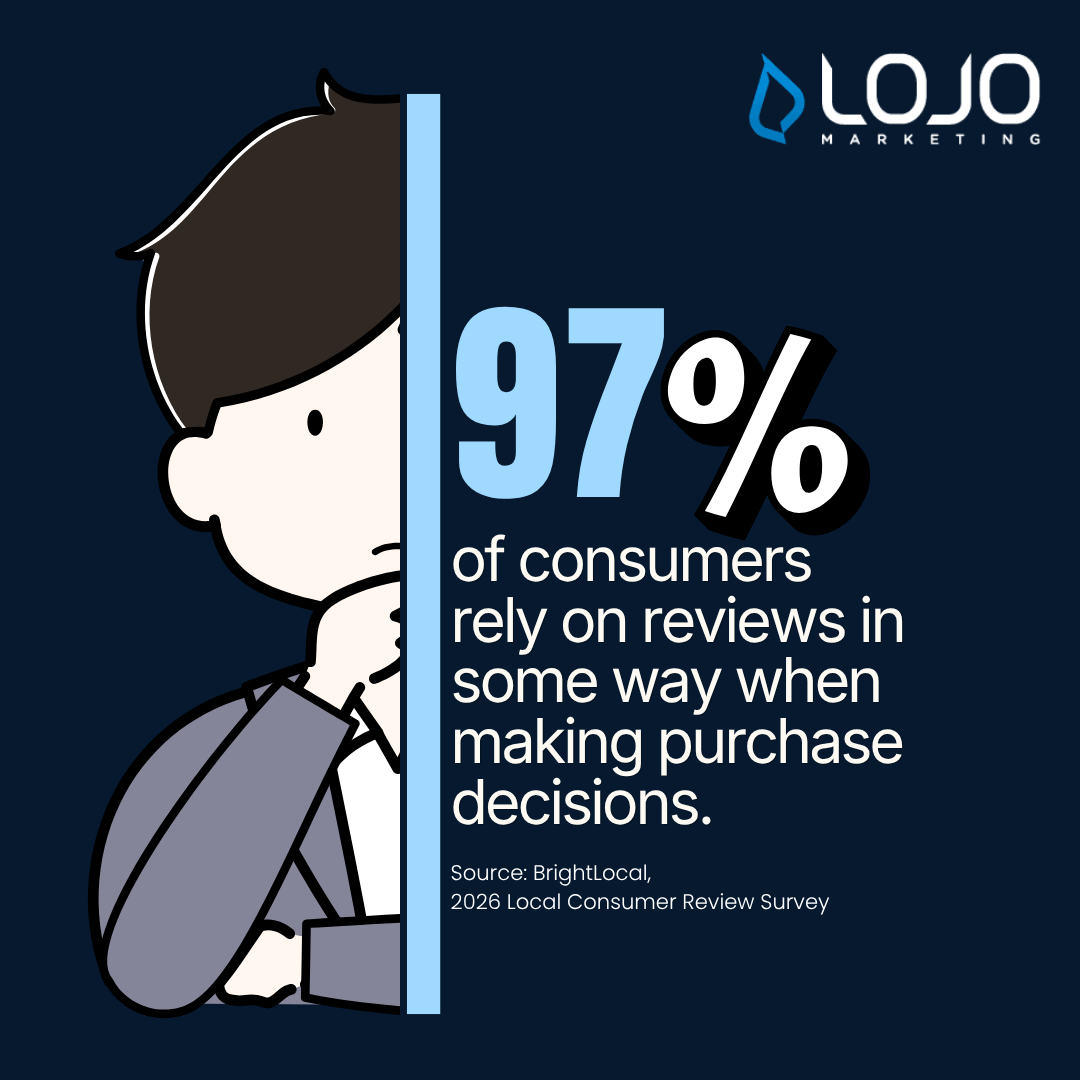
And reviews still carry a lot of weight with consumers. BrightLocal's 2026 Local Consumer Review Survey found that 97% of consumers rely on reviews in some way when making purchase decisions. It also found that 45% had used an AI tool for a local business recommendation during the previous year, up from 6% the year before.
Make it easy for your customers to leave feedback and encourage them to share a little about their experience. The more specific the review, the more useful it can be to future customers—and potentially to the AI systems trying to understand what your business does.

People Are Using AI, but They Still Check the Details
AI is becoming part of local search quickly, but customers are not abandoning traditional search.
Ask Maps shows where Google is taking local search. And consumer behavior suggests people are becoming more comfortable using AI as part of how they find local businesses.
BrightLocal published additional consumer search research in July 2026 based on how people recently searched for local businesses. It found that:
84% had searched for a local business online within the previous three months.
73% conducted their most recent local search on a mobile phone.
Three out of four consumers used more than one channel during their most recent local business search.
23% used AI during that most recent search.
31% use AI for local recommendations at least monthly.
And there is another important number.
Among consumers already using AI for local search, only 18% were ready to contact the recommended business immediately. Most continued researching through Google or another source before making a decision.
That means the customer journey may look something like this:
Ask AI → See a recommendation → Check Google → Read reviews → Visit the website → Call or book
So the goal should not be to optimize one platform in isolation. Your information needs to make sense wherever the customer checks next.
What Should Businesses Update?
This does not require chasing every new AI feature. Start with the information that already matters to your customers.
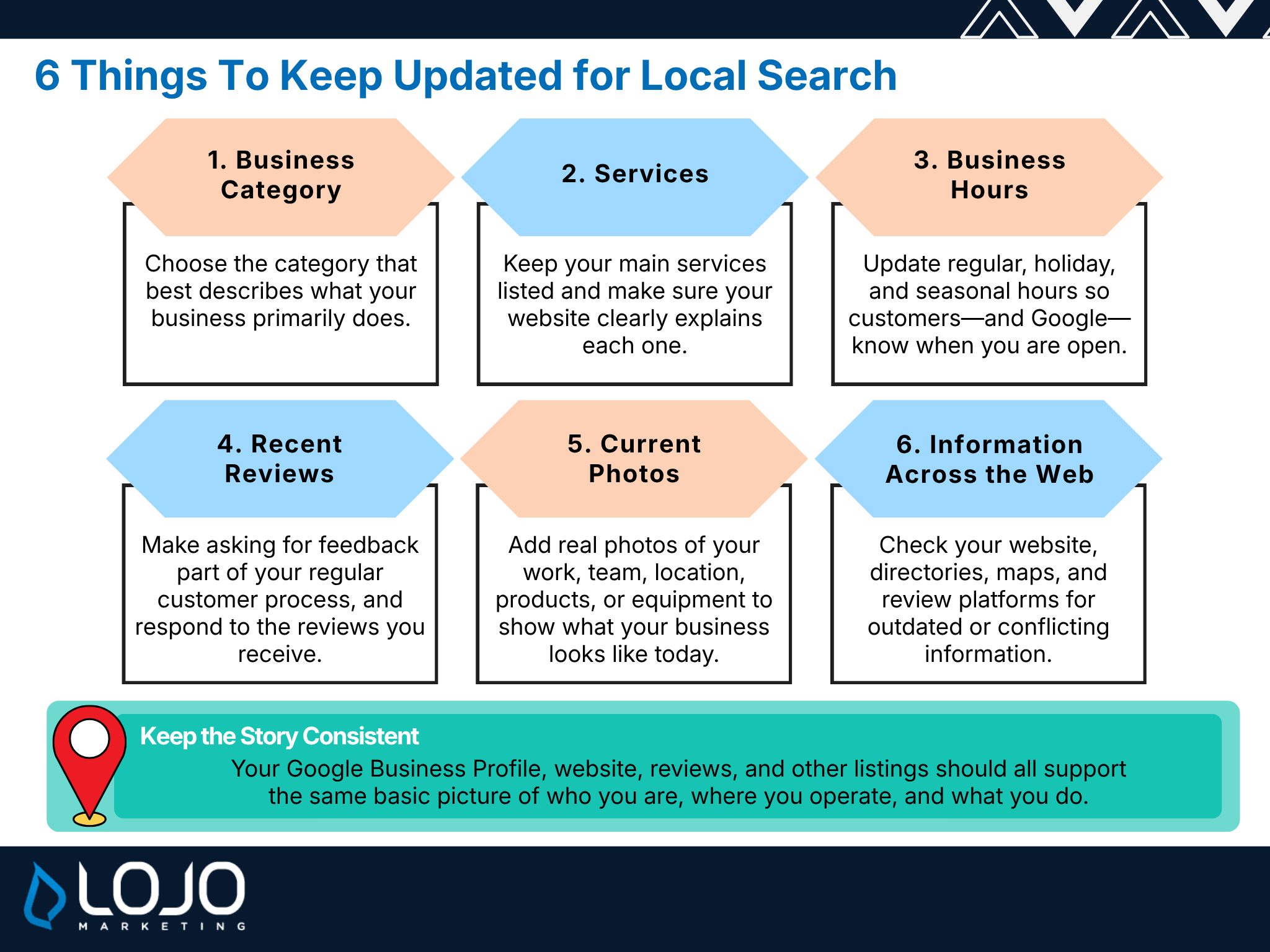
1. Check your primary business category
Your primary Google Business Profile category remains one of the strongest controllable signals for local search.
Choose the most accurate category for what your business primarily does.
Do not select categories simply because you want to rank for more searches.
2. Review your services
Make sure your major services are actually listed. Use the language customers would understand, and check whether each important service has a useful page on your website.
Whitespark's 2026 research ranked dedicated service pages second among AI search visibility factors.
3. Keep your hours accurate
Review regular hours and special hours before holidays or seasonal changes. Someone searching for a business that can help them now may never see a company Google believes is closed.
4. Keep earning recent reviews
Avoid treating reviews as an occasional campaign. Instead, build requesting feedback into the normal customer process. Make sure to also respond thoughtfully when customers take the time to leave feedback.
5. Add current, real photos
Show completed projects, your team, your location, products, equipment, or examples of your work. Photos can help customers understand the business before they contact you, and they give Google's systems additional context about the place or company.
6. Check the rest of the web
Compare the information on your Google Business Profile with:
Your website
Facebook
Apple Maps
Bing
Industry directories
Local directories
Major review platforms
You need your important sources to agree on who you are, where you operate, and what you do.
How Do You Know Whether It Is Working?
This may be the most important question. Visibility alone does not pay the bills.
Google Business Profile provides performance reporting for:
Searches
Profile views
Calls
Direction requests
Website clicks
Messages
Bookings
Menu interactions and other category-specific actions
And Google made an important reporting improvement in June 2026. Businesses can now connect Google Business Profile directly with Google Analytics 4.
Once linked, GA4 can report seven core GBP metrics:
Interactions
Calls
Bookings
Directions
Website clicks
Messages
Menu interactions
Google says linking Business Profile with Google Analytics can provide a more complete view of the customer journey, from local discovery to online conversion. GBP data is available on a rolling six-month basis.
That creates a much better measurement framework. Ranking still matters, but it is only one part of the picture.
The more useful question is what happens after someone finds you. Are more people calling? Are they requesting directions, visiting the website, booking, or becoming leads?
Those actions give you a better sense of whether your local visibility is actually turning into business.
Your Google Business Profile Is Still Important. Its Job Has Changed.
Google Business Profile is not disappearing. In many ways, it is becoming more important because the information inside it can help power several different customer experiences.
A customer may find you through Maps. Another may encounter an AI Overview. Someone else may ask Ask Maps a detailed question. Another may ask ChatGPT for recommendations and then check your Google reviews before calling.
The businesses that are prepared for this shift are not necessarily the ones using the most AI tools, but those that are making themselves easy to understand. Their hours are correct, their services are clear, their reviews are current, their website explains what they do, and their information matches across the places customers—and AI systems—look for answers.
That is good local marketing regardless of how Google changes the search results next.
And in an AI-driven search environment, clarity may be one of the strongest advantages a local business can build.