TO LEARN IS TO GROW
Learning Center
We do our research and publish our results. Should probably call this the Growing Center.

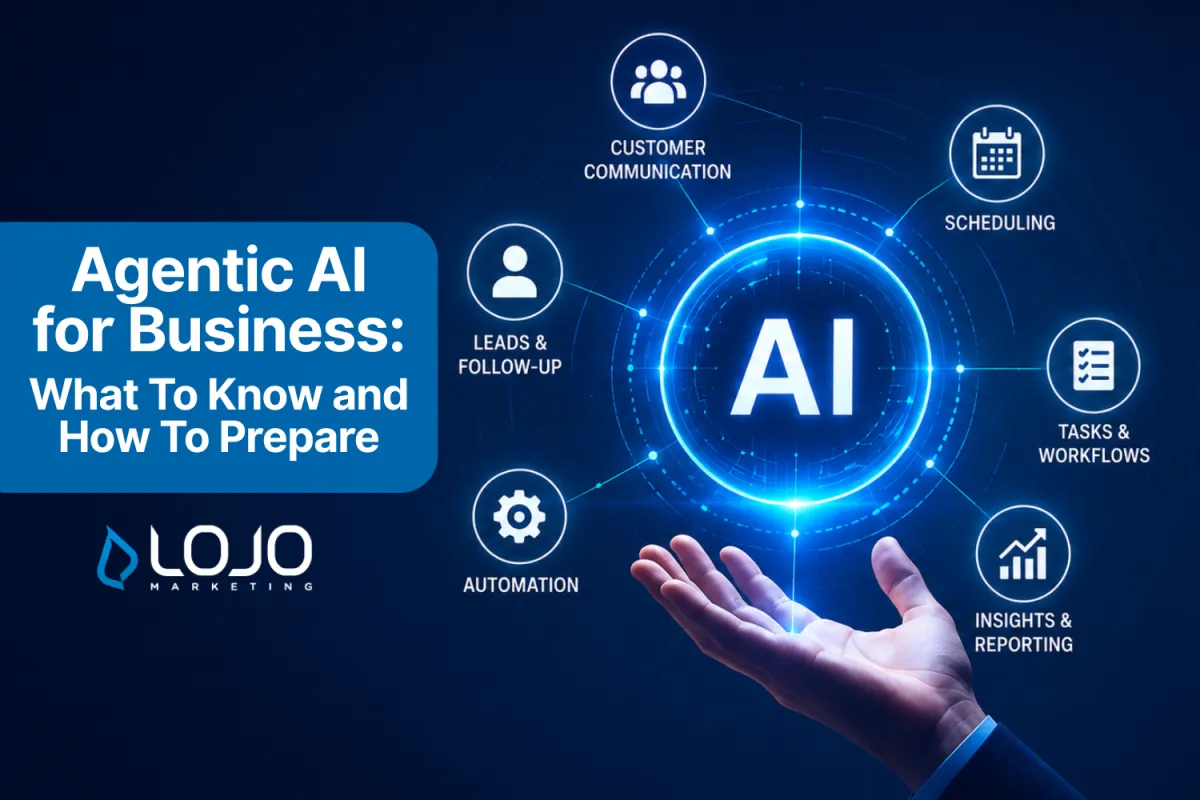
Agentic AI for Business: What To Know and How To Prepare
AI is changing, yet again. And while that may feel tiring, it is also expected.
For the past few years, much of the conversation has been about using AI to write content, answer questions, summarize information, or speed up simple tasks.
Across industries, AI access has grown quickly. Recent research shows worker access to AI tools has increased by 50% in the last year, and McKinsey reports that AI adoption has reached 88% of organizations.
Still, having access to AI does not automatically make it useful. More businesses have AI tools available now. The harder part is knowing where those tools fit, what work they should support, and what needs to be cleaned up first.
That question becomes more important as AI starts moving beyond chat. AI tools are beginning to do more than respond; they are starting to help people take action.
That may look like comparing service options, helping someone decide what to do next, pulling information from connected tools, or helping a team move work from one step to another.
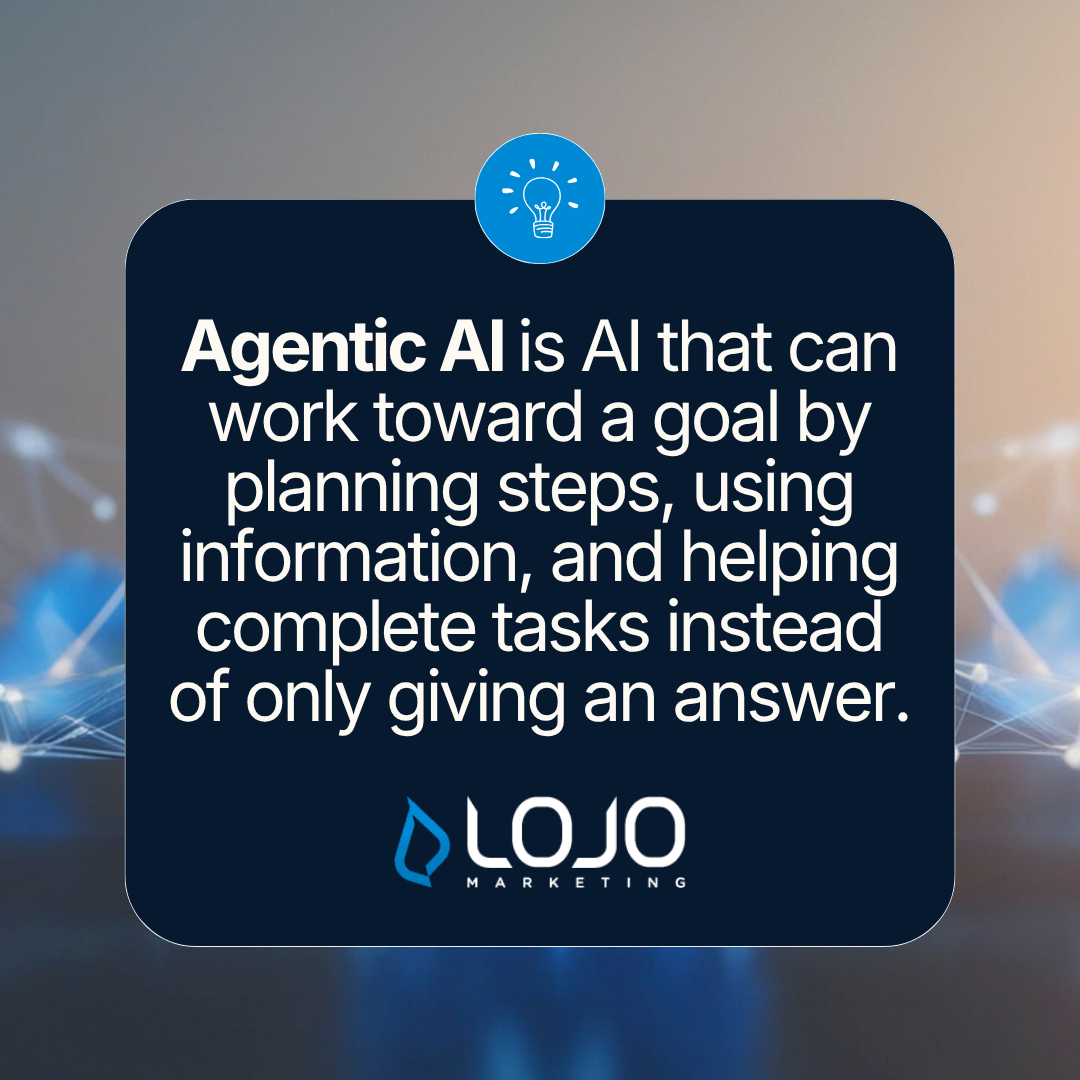
This is often called agentic AI. In simple terms, it means AI that can help work toward a goal by planning steps, using information, and completing tasks instead of only providing an answer.
The businesses that are better prepared for this shift will not always be the ones using the most advanced tools, but those with clear information, organized systems, and thoughtful processes that help customers and teams take the next step with confidence.
In this article, we’ll break down what the agentic AI shift means, why it matters for your business, and what practical steps you can take now to prepare.

AI Use Is Growing Faster Than Business Readiness
AI adoption is growing quickly, but deeper business change is moving more slowly. Deloitte reports that 23% of companies are using agentic AI at least moderately today, and 74% expect to use it at least moderately within the next two years. Gartner also projects that up to 40% of enterprise applications will include task-specific AI agents by 2026.
That means more businesses will likely see AI agents built into the tools they already use, from CRMs and email platforms to customer service systems, reporting tools, and project management software.
But there is another side to the data.
Deloitte also found that only 34% of companies are using AI to deeply transform their business. Another 37% are using AI at a surface level, with little or no change to the way work actually happens.
That gap is worth paying attention to.
AI is becoming easier to access, but the value still depends on the business behind it. If the process is unclear, the tool has less to work with. If customer information is scattered, AI may miss important context. If service details are outdated, AI may repeat the wrong information. And if no one owns the next step, automation may only move the confusion faster.
Surface-level usage is no longer a sustainable strategy; it provides marginal gains while ignoring the structural advantages of autonomous systems. As noted by industry analysts at Aggentic:
“Businesses are moving from asking whether AI can help people work faster to asking whether AI can handle pieces of work on its own. The market in 2026 is no longer just about chatbot excitement, it is about operational adoption, software integration, [and] ROI...”
Search Is Becoming Less About the Click Alone
For years, many businesses thought about online visibility in a simple way: show up in search, get the click, bring someone to the website.
But search behavior is changing. In the first four months of 2026, SparkToro found that 68.01% of Google searches in the U.S. ended without a click. Search Engine Land summarized the same study by noting that Google’s AI answers are keeping more users on the platform, with AI Overviews reducing click-through rates and AI Mode expected to increase that trend over time.
In other words, people may still find your business through search, but they may not always reach your website first. AI Overviews, featured snippets, map results, business profiles, and AI-powered search tools can all help people compare options, ask questions, and make decisions without clicking through right away.
That means your website and online presence need to be easier to understand, summarize, and reference.
And this is where AI search visibility comes in. Some people call this Generative Engine Optimization, or GEO, which means creating and structuring your online information so AI-powered search tools can understand it, use it accurately, and potentially cite or reference it in an answer.
For example, say someone searches, “What should I look for in a local HVAC company?” An AI-powered search result may summarize what matters, such as service area, emergency availability, licensing, customer reviews, and maintenance options. If an HVAC company clearly explains those details on its website, keeps its Google Business Profile updated, and answers common customer questions, it has a better chance of being understood and referenced in that type of answer.
In traditional SEO, the goal was often to rank higher and earn the click. In AI-powered search, another goal is becoming more important: making sure your business information is clear enough to be included, cited, or summarized when someone asks a relevant question.
But hold your horses, this does not mean abandoning SEO altogether, but all the more emphasizes the need to strengthen the basics that already matter:
Say clearly what you do
Explain who you help
Keep your service pages updated
Answer common customer questions directly
Make your location and contact information easy to find
Keep your Google Business Profile and other listings accurate
Build reviews and respond to them
Use clear headings and page structure
Add FAQs where they are genuinely helpful
Keep important information near the top of the page
Another thing: Don’t make the mistake of writing for robots. Instead, make your business easier for BOTH people and AI-powered tools to understand.
AI systems often pull from information that is clear, current, structured, and easy to summarize. If your services are vague, your listings are outdated, or your content is buried under long introductions, your business may be harder to include in the answers people see.
This is why clarity is becoming a visibility issue. A business that explains its services plainly, keeps its information consistent, and answers real customer questions gives search engines, AI tools, and customers a better path to understand what it offers.
Ranking still matters. Clicks still matter. But in the agentic AI era, being understood may matter just as much.
Watch: Zero-Click Searches: Why Your Traffic Is Dropping and What To Do About It
Search is changing, and fewer people are clicking through to websites the way they used to. In this Community Connect session, we walk through what zero-click searches mean, why they matter for your online visibility, and what you can do to make your business easier to find, understand, and trust.
We have a small business community you can join for resources, conversations like these, and support as you grow your business. Join us today. We’d love to have you with us.
AI Needs Guardrails Before It Takes Action
As AI becomes more active, businesses need to think more carefully about control. Recent research shows that 82% of executives are rethinking their strategies around AI, but only 21% have mature governance models in place for autonomous agents.
In looking at this figure, we need to highlight how agentic AI is different from a basic chatbot.
A chatbot may answer a question or draft a message, while an AI agent may be connected to tools, customer records, calendars, emails, internal documents, forms, workflows, or payment-related systems. That means it may be able to do more than provide information and take steps inside the business. And this requires clear boundaries.
Government cybersecurity guidance from groups like the Cybersecurity and Infrastructure Security Agency (CISA) and the National Security Agency (NSA) warns that agentic AI can create a wider security risk because these systems may interact with external tools and internal data.
There are a few risks businesses should understand:
Bad instructions: Someone could try to manipulate an AI tool into doing something it should not do.
Poor or misleading data: If the information going into the system is wrong, the AI may make poor recommendations or take the wrong next step.
Too much access: If an AI tool has permission to view, change, or send too much information, a small mistake can become a bigger issue.
Unclear accountability: If no one knows who reviews AI actions, it becomes harder to catch mistakes or explain what happened.
AI should be given responsibility slowly and thoughtfully. A practical approach is to start with low-risk tasks first. Let AI help draft, summarize, organize, remind, or suggest before giving it permission to act on its own.
For example, you might start by using AI to:
Draft a follow-up email for a team member to review
Summarize a customer conversation
Suggest next steps for a lead
Organize notes from a meeting
Flag incomplete contact records
Prepare a report draft
From there, you can decide what should stay human-reviewed and what may be safe to automate later. You want to make sure AI supports the work without creating confusion, privacy issues, or unnecessary risk.
Simple AI Guardrails Worth Setting First
Good AI guardrails can be simple:
Decide what AI tools the team is allowed to use
Be clear about what information should not be pasted into AI tools
Keep a person involved in customer-facing decisions
Review AI-generated content before publishing or sending
Limit access to sensitive customer or business data
Make sure someone owns the process if something goes wrong
As AI becomes more capable, trust will matter as much as speed. The businesses that use AI well will not be the ones that simply give it unlimited access—they will be the ones that use it with clear rules, human judgment, and the right level of control.

Your Customer Data Needs To Support the Next Step
Your CRM is a tool where customer information is supposed to live. However, in reality, that information is often spread across too many places: inboxes, text messages, forms, spreadsheets, notes, calendars, missed calls, and team conversations.
And that creates a real problem. If the information is scattered, the follow-up becomes scattered too. A lead may submit a form, receive one reply, ask a question by text, get mentioned in a team conversation, and then sit untouched because no one has a clear view of what happened next.
This is another issue that AI and automation address. The next phase of CRM will not just be for storing contact records but for helping businesses understand the relationship, organize the context, and move the work forward.
That could look like:
Summarizing past customer conversations
Flagging leads that have not received a reply
Updating contact records from forms or conversations
Helping identify where someone is in the sales process
Reminding the team when a next step is overdue
Pulling customer details together before a call or appointment
For many businesses, this can make a huge difference because, oftentimes, follow-up problems are caused by information being hard to find, hard to update, or easy to forget.
On another note, while it’s true that AI can help reduce some of the manual work that makes CRMs hard to maintain, it still needs a clear structure. If the pipeline stages are confusing, AI will not know what progress looks like. If the contact records are incomplete, AI may miss important details. If the team does not have a follow-up process, AI may not know what the next step should be.
Use AI to make customer information easier to use, so your team can respond faster, follow up more consistently, and give people a clear path from first contact to next step.
AI Will Change Tasks Before It Changes Job Titles
As AI and automation become more common, businesses will need to think about how work is changing for the people doing it.
The research points to a real gap. While 82% of companies expect automation to affect at least 10% of their roles within the next three years, 84% have not yet started redesigning those roles. At the same time, only 13% of non-technical workers say they feel highly enthusiastic about the technology.
That tells us something important. The challenge now is not only whether a business has access to AI, but whether the team understands how AI fits into the work.
You may need to clarify:
Which tasks AI can help with
Which tasks still need human judgment
Who reviews AI-generated work
Who owns the next step after AI makes a suggestion
What information the team is allowed to use inside AI tools
How AI should support customer communication without replacing care and common sense
In general, most people do not resist helpful tools; they resist confusion. So if AI is introduced without clear expectations, it can feel like one more thing to learn, manage, or worry about. Team members may wonder whether they are supposed to use it, when they are allowed to use it, or whether it changes what they are responsible for.
Leadership comes in here. Your business may need someone to guide how AI is used. This does not have to be a technical role but can simply be a person who understands the work, knows the customer experience, and can help the team decide where AI should assist and where a person should stay involved.
A simple way to start is to look at tasks, not job titles.
Where is the team repeating the same steps?
Where are people copying and pasting information?
Where are follow-ups delayed because someone has to remember them manually?
Where are notes, updates, or reports taking more time than they should?
Where could AI prepare a draft, summary, or reminder for a person to review?
AI can help with execution, but people still need to guide the work. The businesses that handle this shift well will be the ones that give their teams clarity, not just another tool.
Preparing for AI Without Overcomplicating the Business
The agentic AI shift can create pressure, especially when it feels like every tool, platform, and headline is moving at once. But you do not need to chase every update to make progress.
A better starting point is to make the business easier to understand, manage, and support with clear service information, organized customer data, simple workflows, thoughtful automation, and human review where it matters.
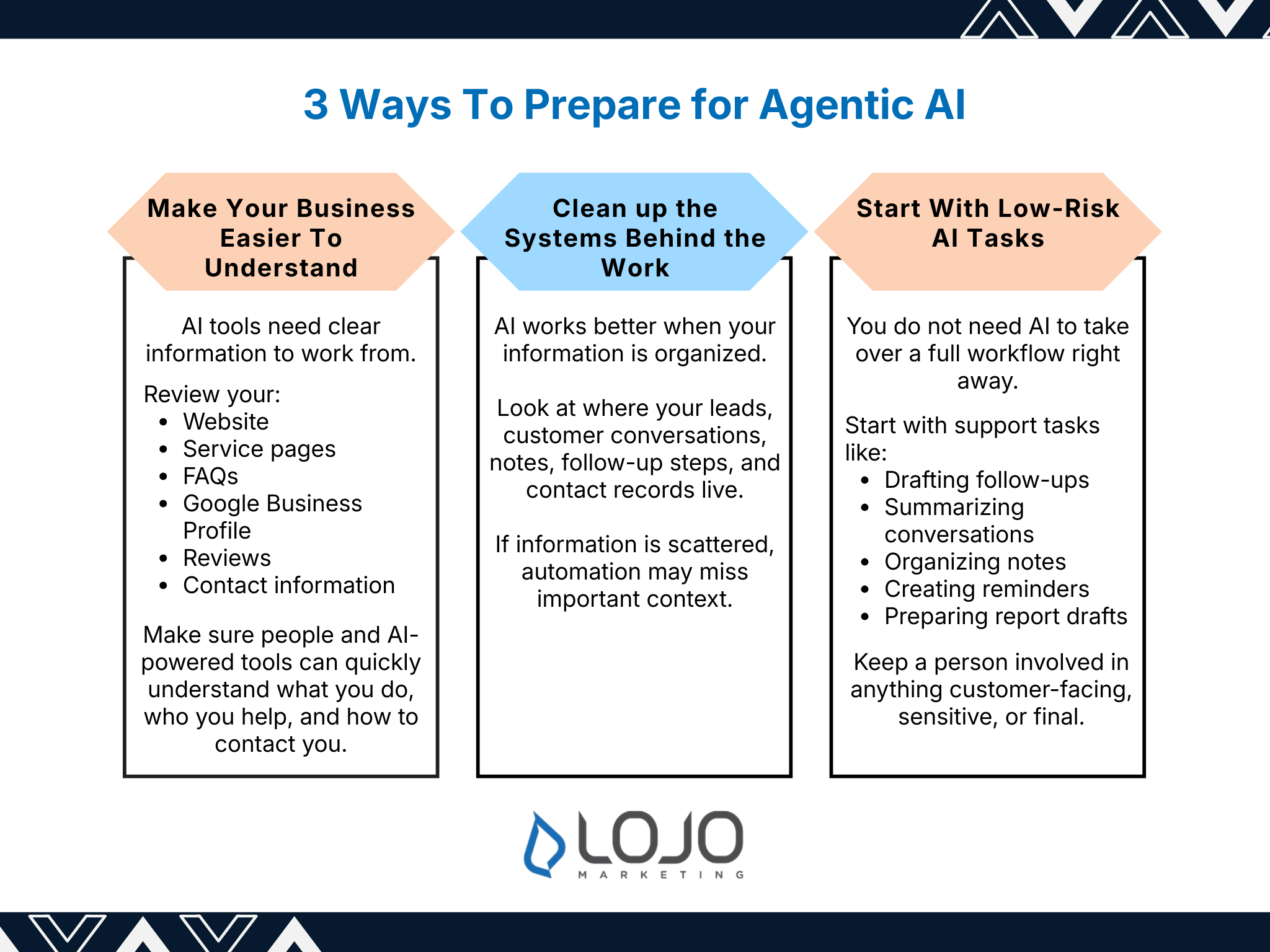
Your 90-Day Agentic Roadmap
1. Review what customers and AI tools can understand
Look at your website, Google Business Profile, service pages, FAQs, reviews, and contact information. Make sure the public-facing information is clear, current, and useful.
Ask:
Is it clear what we do?
Is it clear who we help?
Are our services explained plainly?
Are our hours, location, and contact details accurate?
Do we answer the questions customers ask most often?
Is important information easy to find near the top of the page?
2. Clean up the systems behind the work
AI can only support the work well if the information behind it makes sense.
Review where customer information lives. Look at your forms, inboxes, CRM, spreadsheets, calendars, notes, and follow-up process.
Ask:
Where do leads come in?
Who follows up?
What happens after someone fills out a form?
Where are customer conversations stored?
Are pipeline stages clear?
Are contact records complete enough to be useful?
Where does the team lose time repeating manual steps?
This is not about building a perfect system but about finding the places where unclear information or scattered tools slow the business down.
3. Add AI carefully, starting with low-risk tasks
AI does not need to take over a workflow on day one.
Start with tasks where it can support the team without creating unnecessary risk, such as drafting follow-up messages, summarizing conversations, organizing notes, preparing report drafts, creating reminders, or helping identify missing customer information.
Keep a person involved in anything customer-facing, sensitive, or final.
As your business becomes more comfortable with AI use, you can then decide where automation makes sense and where human judgment still needs to lead.

Final Thoughts
AI may be moving from answers to action, but people still set the direction.
The businesses that are better prepared for this next phase will not always be the ones using the most tools. They will be the ones with clear information, organized systems, thoughtful processes, and teams that understand how AI should support the work.
You do not need to figure it all out at once. Start with clarity, clean up what is scattered, choose one or two practical places where AI can help, and then build from there with care.
If your business is trying to make sense of AI, automation, or better systems, LOJO Marketing can help you identify the next right steps.

We use and recommend GrowthGenie360, a CRM and automation software that helps businesses manage leads, customer communication, follow-up, scheduling, workflows, and other sales and marketing activities in one place.
Book a call to review where your systems may need more clarity and what changes would make the biggest difference for your business.


Built for Growth. Backed by 25 Years of Trust.
For over two decades, LOJO has been a trusted partner to hundreds of businesses just like yours. Whether working directly with owners, managers, teams, or boards of directors, our goal remains the same: to be a reliable and results-driven asset to your business.
Over the years, we’ve carefully built a team of experts—each selected for their unique skills, strengths, and personalities. Our clients choose LOJO because they know we genuinely care about their success.
And after 25 years of helping businesses grow, we’re more committed than ever.

Built for Growth. Backed by 25 Years of Trust.
For over two decades, LOJO has been a trusted partner to hundreds of businesses just like yours. Whether working directly with owners, managers, teams, or boards of directors, our goal remains the same: to be a reliable and results-driven asset to your business.
Over the years, we’ve carefully built a team of experts—each selected for their unique skills, strengths, and personalities. Our clients choose LOJO because they know we genuinely care about their success.
And after 25 years of helping businesses grow, we’re more committed than ever.


Matthew Rogers, President
iProspect Check
After spending several months reviewing multiple proposals from several different companies we engaged LOJO to develop a new website that represents our company effectively. We worked initially with Stephen Platte who helped create the scope of the project. Stephen was knowledgeable and always followed up with me on time and as promised.
He "closed the deal" for LOJO with his professionalism, service orientation and easy going approach. Once we signed the contract we were introduced to Jay Kelly who would be the creative lead for LOJO. This was the most challenging part of the project for my company, as there was no shortage of ideas from our side. Jay managed the project flawlessly, and once we had all agreed to the design, Jay introduced us to Eric.
Eric Lay is one of the founders of LOJO. Eric took the design we had developed and brought it to life. We delivered content as quickly as he requested it. Eric kept the project on task and we responded by exceeding every deadline for content. In turn, once provided, literally not a day went by that Eric didn't add the content and take the next step. In just a few weeks we launched our new website. Eric is a pleasure to work with.
His positive attitude and consultative approach really enhanced the experience and made a big difference for us in the outcome of our project. We would welcome you to visit our website to take a look at the quality work of LOJO. We are very pleased with LOJO and look forward to working with them in the future as we pursue an aggressive SEO strategy."
After spending several months reviewing multiple proposals from several different companies we engaged LOJO to develop a new website that represents our company effectively. We worked initially with Stephen Platte who helped create the scope of the project. Stephen was knowledgeable and always followed up with me on time and as promised.
He "closed the deal" for LOJO with his professionalism, service orientation and easy going approach. Once we signed the contract we were introduced to Jay Kelly who would be the creative lead for LOJO. This was the most challenging part of the project for my company, as there was no shortage of ideas from our side. Jay managed the project flawlessly, and once we had all agreed to the design, Jay introduced us to Eric.
Eric Lay is one of the founders of LOJO. Eric took the design we had developed and brought it to life. We delivered content as quickly as he requested it. Eric kept the project on task and we responded by exceeding every deadline for content. In turn, once provided, literally not a day went by that Eric didn't add the content and take the next step. In just a few weeks we launched our new website. Eric is a pleasure to work with.
His positive attitude and consultative approach really enhanced the experience and made a big difference for us in the outcome of our project. We would welcome you to visit our website to take a look at the quality work of LOJO. We are very pleased with LOJO and look forward to working with them in the future as we pursue an aggressive SEO strategy."
Matthew Rogers, President
iProspect Check
The team at LOJO were wonderful to work with. They are well organized and very patient as we worked through our marketing strategy and developed a well thought out and clear action plan at a reasonable price. We will definitely be back for our future campaign needs."

Jon Crosby, Founder
Dazil