

Practical guides for owners who want to grow
We research what is working in marketing, AI and automation and publish it in plain language you can act on this week.
More than 300 articles from a decade of growing local businesses
[[countLabel]]
Tools to find your next win
 FREE AUDIT

Get one useful idea in your inbox each month
News, guides and announcements from LOJO. No spam, unsubscribe any time.
Get one useful idea in your inbox each month
News, guides and announcements from LOJO. No spam, unsubscribe any time.
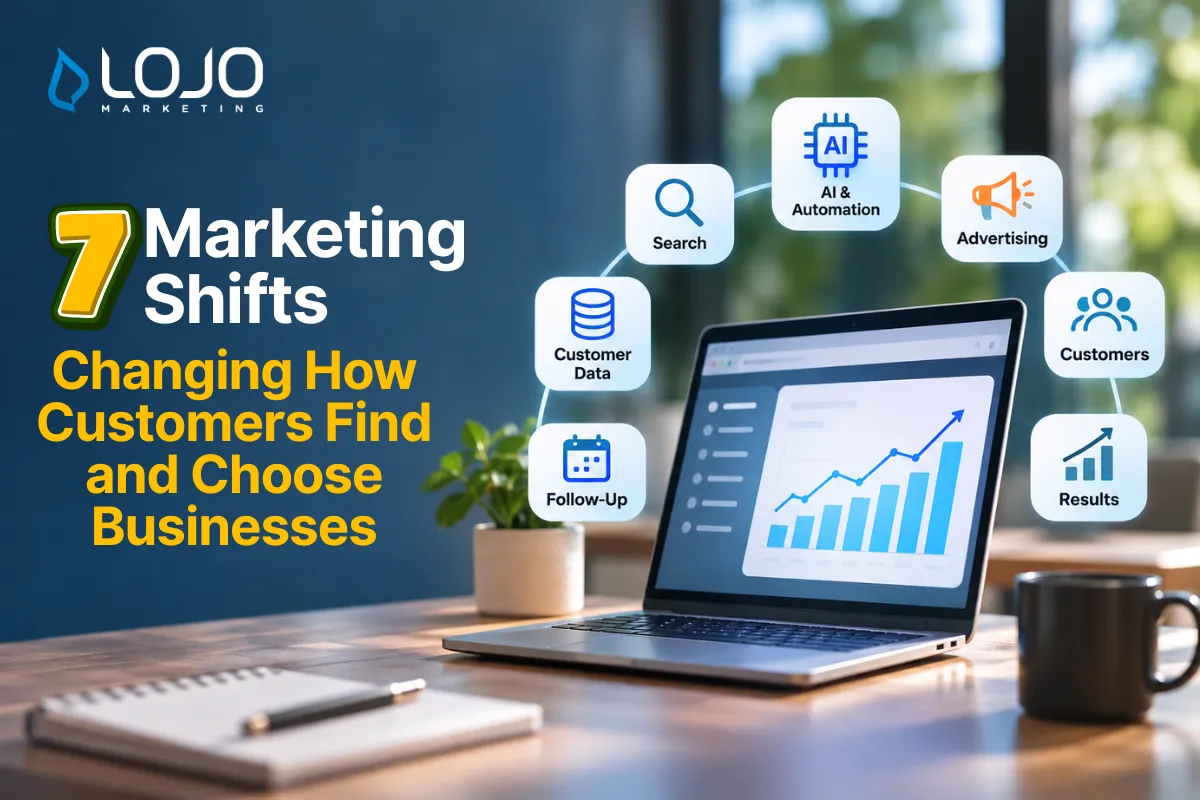
Marketing Is Changing Fast. Here Are 7 Shifts That Actually Matter.
When you run a business, it can feel like marketing changes every week.
Google adds another AI feature. A new way to advertise appears. Someone says SEO is dead. Another says you need an AI agent. Then there is a new acronym to learn before you've figured out the last one.
It is a lot to keep up with.
But worry not; most business owners do not need to react to every announcement. What matters more is understanding the larger changes underneath them.
If you are trying to sort through those changes and decide what matters for your business, book a call. We can take a look at what you are doing now and help you figure out where your time and budget are best spent.
No matter the change, customers are still looking for businesses. They are still comparing their options and trying to decide who they trust and who they want to contact.
But the path they take is becoming less predictable. Someone might find your business through Google, see a social post a few days later, read your reviews, ask an AI tool about your services, visit your website, and finally call when they are ready.
That shift affects more than search. It changes how businesses should think about advertising, content, websites, customer communication, follow-up, and measurement.
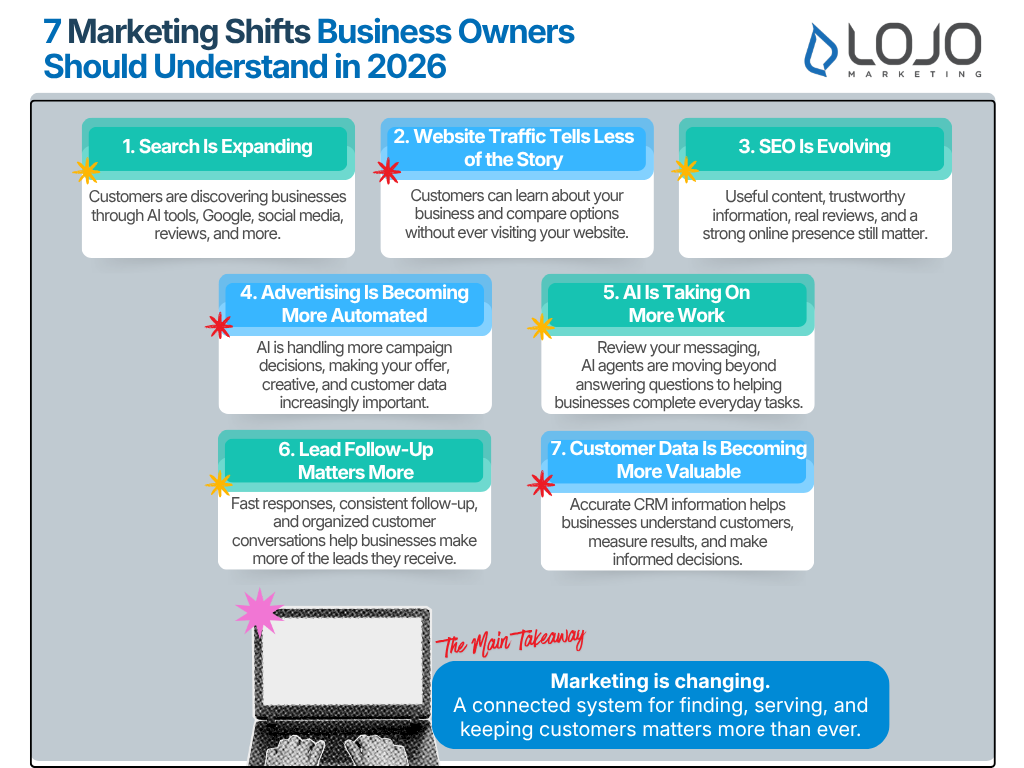
We’ve discussed below the seven changes deserving of your attention.

7 Marketing Shifts Changing How Customers Find and Choose Businesses
1. Customers are searching in more ways
Google is still a major part of how people find information. But what we call “search” is getting much broader.
People can type a question into Google, upload an image, speak a request, ask an AI assistant, search YouTube or TikTok, look through Maps, read Reddit discussions, or move between several of those sources before making a decision.
Google itself is leaning heavily into this change. In a May 2026 announcement, Google said AI Mode had surpassed one billion monthly users, with queries more than doubling each quarter since launch. The company also said overall Google Search queries had reached an all-time high.
That is an important distinction.
AI search is growing quickly, but the evidence does not suggest people have simply stopped using traditional search. Instead, they are gaining more ways to look for information.
Think about someone planning a kitchen remodel. They might ask Google for contractors nearby. Then they could search Instagram for ideas, watch a YouTube video about costs, read reviews, ask ChatGPT what questions to ask a contractor, and return to Google to research the companies they found.
Your business may appear at several points along that journey.
What this means for your business
Being visible online no longer means ranking for a few keywords and waiting for someone to click your website. Your business should be easy to understand wherever a potential customer encounters it. That includes your:
Website
Reviews
Business directories
Photos and videos
Industry profiles
Other places customers use to research your type of business
The information does not need to be identical everywhere, but the basics should agree.
What do you do?
Who do you help?
Where do you work?
Why should someone trust you?
How can they contact you?
You don’t have to be on every platform; you simply have to make sure people can recognize and understand your business on the platforms that matter to your customers.
2. Customers can learn about you without visiting your website
For years, website traffic has been one of the easiest ways to judge online visibility. Someone searches, they click, then they visit your website.
Now AI-generated answers are changing some of that behavior. A Pew Research Center study analyzed browsing activity from 900 U.S. adults. When a Google AI summary appeared, users clicked a traditional search result in 8% of visits. When no AI summary appeared, they clicked a traditional result in 15% of visits. Links inside the AI summaries themselves were clicked in only about 1% of visits.
While one study should not be used to predict what will happen to every website, as different industries and searches behave differently, the larger direction is particularly worth paying attention to: people can increasingly get useful information before visiting the source website.
Google has continued expanding those AI experiences since Pew conducted the research. In June 2026, they even introduced additional Search Console reporting to help website owners understand their visibility in AI-powered search experiences.
A customer might now:
→ See your business mentioned in an AI answer.
→ Look at your Google reviews.
→ See photos of your work.
→ Watch one of your videos.
→ Read what someone else says about your company.
→ And only visit your website when they are much closer to making a decision.
What this means for your business
Website traffic is still useful, although traffic alone is becoming a weaker way to judge whether your marketing is working.
You also need to look further down the customer journey:
Phone calls
Contact forms
Qualified leads
Appointments
Estimates
Proposals
Sales
Revenue
Repeat customers
You may also need to become more comfortable with something marketers have always struggled with—not being able to see every step that influenced someone's decision. Because a customer may encounter your business several times before your analytics ever recognize them.
The question becomes less about whether every interaction generated a click and more about whether your overall visibility is helping the right people find and choose you.
3. SEO is changing, but it is not disappearing
The growth of AI search has brought a new collection of acronyms with it.
There is AEO, or answer engine optimization.
There is GEO, or generative engine optimization.
And there are plenty of opinions about whether businesses now need a completely different strategy for getting found.
Google's own guidance is much less dramatic. Google Search Central published guidance specifically addressing optimization for generative AI search, stressing that existing SEO best practices remain “relevant and foundational” because its generative AI features are built on its core search ranking and quality systems.
Google's recommendations include many things good businesses should already be doing:
Providing clear local and shopping information
Using helpful images and video
Giving search engines enough information to understand what the business actually offers
What is expanding is the number of places an AI system can use to understand your business.
Your website is one source. So are reviews, directories, videos, business profiles, articles, product information, public discussions, and other trustworthy references.
What this means for your business
Do not publish hundreds of generic articles because someone told you AI search requires enormous amounts of content. Start with the questions your customers actually ask, such as:
What does your service include?
How much does something typically cost?
How long does the process take?
What should someone know before hiring a company like yours?
What problems do you solve?
What areas do you serve?
What mistakes do customers commonly make?
What makes one option different from another?
Useful answers give both customers and search systems more information to work with. Then back those answers up with things that are harder to fake: real reviews, original photos, completed projects, case studies, credentials, customer stories, and expertise that comes from actually doing the work.
This goes without saying that SEO is not becoming irrelevant; it is rather becoming part of a larger system for establishing whether your business is understandable and trustworthy online.

4. Advertising platforms are making more decisions automatically
Paid advertising is changing for a different reason. The platforms themselves are doing more of the work advertisers once handled manually.
Google, Microsoft, Meta, and others increasingly use AI to help make decisions about:
Audience targeting
Bidding
Search matching
Creative variations
Ad placement
Landing pages
Campaign optimization
Microsoft made AI Max for Search generally available in August 2026. The system can expand the searches advertisers appear for, customize ad text, and select relevant landing pages.
Google is moving in the same general direction with its advertising products.
And AI companies themselves are becoming advertising platforms. In September 2026, OpenAI announced it was testing Sponsored Agents in ChatGPT, where a user can begin a conversation with a business-sponsored AI agent instead of simply clicking an ad and leaving ChatGPT. OpenAI also announced advertising integrations with HubSpot and Shopify.
None of this suggests businesses are about to stop paying for advertising. Quite the opposite, actually.
The Interactive Advertising Bureau updated its U.S. advertising outlook in September 2026 and increased its expected 2026 ad-spend growth to 12.3%.
What is changing is where the advantage comes from.
What this means for your business
When platforms automate more campaign mechanics, your inputs become more important.
Do you know who your best customers are?
Do you have an offer people actually want?
Does your advertising explain why someone should care?
Do you have good photos, videos, testimonials, and other creative material?
Does your website make the next step easy?
And are you giving the advertising platform useful information about which leads eventually become customers?
AI can make millions of calculations faster than a human, but it cannot magically turn a weak offer into a good one. It also cannot fix a confusing service. And it cannot know which leads are valuable if your business never records that information.
5. AI is moving from helping with work to doing parts of the work
Most businesses first encountered generative AI as a tool that could create something. You've probably used it yourself to write an email, summarize a document, generate some ideas, and draft a social post.
Those uses are still helpful, but AI is moving toward something broader. AI agents can increasingly use tools and information to complete multiple steps toward a goal.
For example, imagine a new lead submits a request at night.
An AI system could potentially read the inquiry, ask a qualifying question, update the CRM, check appointment availability, schedule a time, send a confirmation, and notify the appropriate employee.
That is different from asking ChatGPT to write an email. You see, AI is now participating in the workflow itself.
OpenAI's Agents API, announced in September 2026, reflects that shift. It is designed to support agents that can work with tools, files, code, and other agents over longer-running tasks.
Meta is going in a similar direction. They announced in June 2026 a broader rollout of Meta Business Agent. Meta says these agents can answer business-specific questions, recommend products, qualify incoming leads, book appointments, close sales, and hand a conversation to a human when needed. The company said more than one million businesses were already using Business Agent across WhatsApp and Messenger at the time of the announcement.
But businesses should also keep the adoption numbers in perspective. The Federal Reserve's 2026 Small Business Credit Survey found that 46% of employer firms were using AI and another 15% planned to use it during the following 12 months. Among the businesses already using AI, however, only 7% described it as fully integrated into their business. Nearly half were still experimenting.
There is also a difference between saving time and creating measurable financial results. McKinsey reported in September 2026 that 80% of respondents in its latest global AI survey said AI had improved individual productivity. Only 37% attributed any EBIT impact to their organization's AI use. McKinsey argues that larger gains often require businesses to rethink workflows instead of simply adding AI tools to existing processes.
The biggest gains come from reimagining end-to-end workflows around what the technology makes possible.
The opportunity is not simply to use AI to complete the same tasks faster but to look at where work slows down, gets handed off, or gets forgotten—and decide whether AI or automation can improve the process.
What this means for your business
You don’t need an AI agent everywhere. A good starting point is with places where work already gets stuck.
Maybe leads arrive after hours.
Maybe estimates go out, and nobody follows up.
Maybe customers repeatedly ask the same questions.
Maybe appointment reminders are still handled manually.
Maybe employees are copying information from one system into another.
Maybe hundreds of old leads are sitting untouched in your database.
Those are useful problems to solve. Sometimes AI will be the answer, or sometimes a simple automation will work better. The bottom line should be improving the process, not adding AI for the sake of saying you use AI.
6. What happens after the lead comes in matters more
Businesses spend a lot of time thinking about how to generate leads.
How many people saw the ad? How many clicked? How many visited the website? How many filled out the form?
But there is another question that deserves just as much attention: What happened next?
We covered this in more detail in What Happens After a Click? Building a Lead Generation System, where we looked at how lead generation, follow-up, and sales need to work together after someone raises their hand.
Imagine a lead comes in at 7:42 p.m.
Does anyone respond?
If the person does not answer the phone, do they receive a text?
Does someone try again tomorrow?
If they schedule an appointment, do they get a reminder?
If they receive an estimate but do not make a decision, does anyone follow up a week later?
What about a month later? Or six months later?
For many businesses, there is a lot of potential revenue hiding between ‘new lead’ and ‘closed customer.’
The growth of AI and automation matters here because it’s becoming easier for a smaller team to handle some of that communication consistently. We see this firsthand with GrowthGenie360. A business can use automation to respond when a new lead comes in, continue following up when someone does not respond, send appointment reminders, keep conversations organized, and bring older leads back into the conversation. Its AI system can also help handle routine questions and conversations while giving the team a chance to step in when a person is needed.
The point of utilizing AI is not to remove people from the process. You want to make it less likely that a good opportunity gets missed simply because your team got busy.
The Federal Reserve's small-business data also shows that businesses using AI are already reporting operational benefits. Among AI-using firms in its 2026 survey, 71% reported increased productivity, 39% reported improved quality of goods and services, and 31% reported increased sales. Those numbers do not prove AI caused every improvement, but they show businesses are finding practical uses beyond simply generating content.
What this means for your business
Before buying more leads, look at what happens to the leads you already receive.
A basic process might look something like:
Inquiry → Response → Qualification → Appointment → Estimate → Follow-Up → Decision
Your process may be different. But what matters is that there is a process.
Your CRM should help your team know who needs a response, who has an appointment, who received an estimate, who needs another follow-up, who became a customer, and who may be worth contacting again later.
The easier it becomes to generate activity with AI, the more important it becomes to have a reliable system behind that activity.
What if more of your business worked in one place?
A lot of the changes covered in this article point back to the same challenge. Businesses are trying to manage more customer touchpoints, more communication, and more technology without adding more complexity.
That is what GrowthGenie360 is built to help with. It brings your website, CRM, customer conversations, calendar, marketing activities, payments, reviews, reporting, and AI tools into one connected system. Which means your team has one place to manage what happens from the first interaction through the ongoing customer relationship (rather than juggling separate tools for each part of the customer journey).
And the best part is you do not have to figure out the setup on your own. GrowthGenie360 includes onboarding and support to help shape the system around how your business already works.
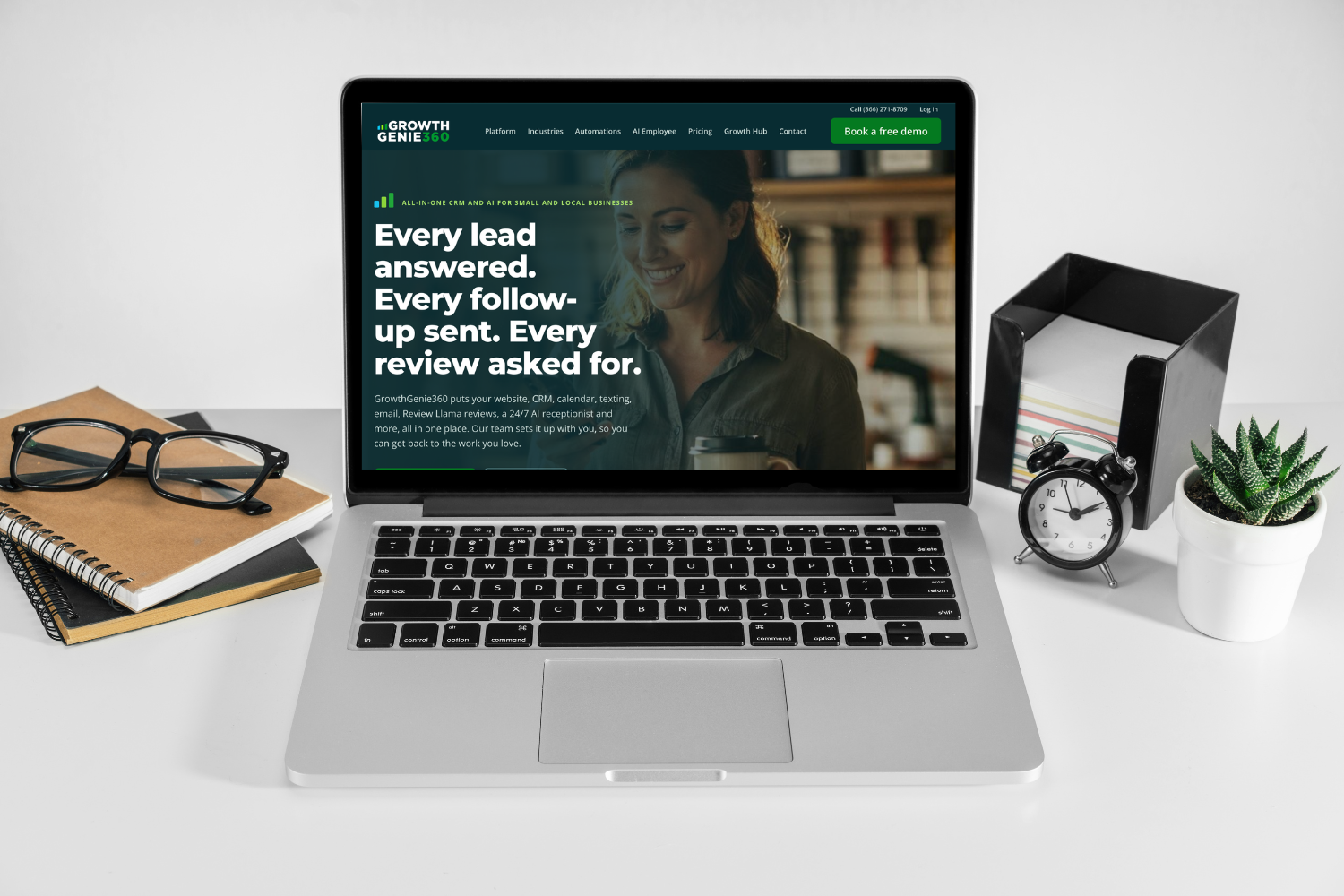
If you are looking at your current tools and wondering what could be simpler, book a tech planning call. We will look at how your business operates today, where things may be getting disconnected or taking more work than they should, and show you how GrowthGenie360 could help bring more of it together.
7. Your customer data is becoming more valuable
There is one more change connecting much of this together.
The major marketing platforms want better information from businesses.
AI advertising works better when platforms understand which actions matter.
Businesses need better data to understand which marketing efforts turn into revenue.
At the same time, privacy rules and changes to tracking are making it harder to follow every customer across the internet.
That pushes more attention toward first-party data.
First-party data is information people provide directly to your business or information you collect through your direct customer relationships, which could include:
Contact information
Lead source
Services someone asked about
Appointments
Estimates
Purchases
Customer status
Communication history
Marketing permissions
Google put this directly at the center of its advertising measurement strategy. The company said modern measurement increasingly depends on a strong data foundation, multiple signals, and methods that can determine whether marketing actually caused a business result.
Independent industry research points to the same challenge. The Interactive Advertising Bureau's State of Data 2026 report said privacy regulation, lost tracking signals, platform automation, and fragmented data are making it harder for marketers to confidently connect advertising exposure to business outcomes.
But collecting more information also creates more responsibility. In July 2026, the Federal Trade Commission and partners in California and Utah sued Hims & Hers, alleging that the company shared sensitive health information with advertising platforms including Meta and Snap despite privacy promises made to consumers. The allegations are pending in court, so they should not be treated as established findings. But the case is a useful reminder that advertising pixels and customer-data integrations deserve careful attention.
Privacy requirements are also continuing to develop at the state level. California's updated CCPA regulations took effect on January 1, 2026, including requirements related to risk assessments, cybersecurity, and certain uses of automated decision-making technology. Some requirements have later compliance dates depending on the provision and business involved.
What this means for your business
Know what customer information you collect, where it is stored, which tools receive it, and which tracking technologies are installed on your website. And make sure the data you keep is actually useful.
A clean CRM that tells you which leads turned into customers may be more valuable than another dashboard showing thousands of anonymous website visits.
You should also go beyond collecting as much information as possible—keep the information that helps you serve customers, understand your marketing, and run your business responsibly.
These changes are more connected than they look
It is easy to look at each of these developments as a separate marketing issue.
AI search affects SEO.
Automation affects ads.
Agents affect customer service.
Privacy affects tracking.
CRM affects sales.
But from a customer's perspective, none of those boundaries exist.
They simply have a problem they are trying to solve.
They discover businesses.
They research them.
They compare options.
They decide who they trust.
They reach out.
They ask questions.
They schedule.
They buy.
And if things go well, they come back or recommend the business to someone else.
With that in mind, the larger shift may be less about any individual technology and more about the growing connection between:
Discovery → Lead Capture → Follow-Up → Sales → Customer Experience → Retention
AI is already beginning to influence every stage, but it does not remove the need for the stages to work together.

What should you actually do right now?
First of all, you do not need to rebuild your marketing strategy every time Google launches something or a new AI tool appears. There are several practical things you can work on now that make sense regardless of which platform wins the next round of attention.
Make sure people can understand your business
Look at your website, Google profile, reviews, social accounts, and other important listings through the eyes of someone who has never heard of you before. Could they quickly understand what you do, who you help, where you work, why they should trust you, and what they should do next?
If that information is unclear to a person, it is probably unclear to an AI system too.
Improve what happens after someone contacts you
Review the leads you have received over the last few months and look closely at what happened next. How quickly were they contacted? Did they receive another follow-up if they did not respond? How many appointments were scheduled? How many estimates went unanswered? How many leads simply disappeared from view?
There may be more opportunity sitting inside your existing database than you think.
Track business outcomes, not only marketing activity
Traffic, impressions, clicks, and rankings are still useful, but they should not be the end of the story. Try to connect your marketing activity to what happens further down the funnel, including qualified leads, appointments, proposals, customers, and revenue.
The closer your reporting gets to an actual business result, the easier it becomes to make better decisions about where your time and budget should go.
Use AI where there is a real problem to solve
Instead of asking where you can add AI, look for places where your business is already losing time or creating friction. Examples include leads waiting too long for a response, inconsistent follow-up, or repeating the same manual tasks every day.
Once you know where the problem is, you can decide whether AI, automation, or a better process is the right solution.
Keep building things your business owns
Platforms, algorithms, ad products, and AI tools will continue to change. That makes the parts of your business you control even more valuable. Keep investing in your website, CRM, customer relationships, reviews, reputation, email list, first-party data, and your understanding of what customers actually need. Those assets remain useful even when the platforms around them change.
The tools will change. The fundamentals still matter.
The pace of marketing change probably is not going to slow down.
Search engines will continue adding AI. Advertising platforms will automate more decisions. Agents will take on more routine work. New channels will appear, while privacy and measurement continue to evolve alongside them.
Trying to react to every announcement would be exhausting. And in many cases, it would also lead you to spend time and money on changes that may not matter to your business.
A better approach is to pay attention to the direction things are moving and make sure the fundamentals underneath your marketing are strong.
Customers are researching businesses in more places and often learning more before they ever reach a website. Advertising platforms are handling more of the mechanics, while AI is making it easier to manage routine work and customer communication. At the same time, the information businesses collect about their customers is becoming both more useful and more important to handle carefully.
All of that puts more attention on the full journey from initial interest to an actual customer. The opportunity is to make that journey easier to manage, not more complicated.
Help the right people find your business, give them useful information when they are researching, and make it clear why they should trust you. When they are ready to take the next step, make that step easy. Respond when they reach out, stay in touch when they are not ready yet, and keep track of which opportunities eventually turn into business.
The technology around that process will keep changing, but the process itself still makes a lot of sense.