TO LEARN IS TO GROW
Learning Center
We do our research and publish our results. Should probably call this the Growing Center.

What Marketing Materials Do I Need for My Business?
What Marketing Materials Do I Need for My Business?
Why Marketing Materials Matter
The Basics: Your "Must-Have" Marketing Materials
2. Your Website and Domain Name
3. Professional Email Addresses
8. Brochures, Flyers, and Postcards
10. Company Uniforms or Branded Apparel
13. Sales and Marketing Support Materials
14. Your Business Blog or Business Center
21. Webinars, Workshops, or Online Events
Additional Marketing Materials
23. Billboards and Out-of-Home Advertising
26. Traditional Advertising Materials
How To Decide What You Need First
A Final Word About Your Marketing Materials
Your marketing materials do more than support sales. They shape how people see your business, understand what you offer, and decide whether they can trust you.
That can feel like a lot when you are already managing day-to-day operations, customer service, hiring, invoicing, and everything else that comes with running a business. You may know you need a website, social media, business cards, email, brochures, or advertising, but knowing what to prioritize first is not always obvious.
The good news is that you do not need every marketing material at once—what you need first is a clear, consistent foundation.
Your materials should help people recognize your brand, understand your value, and know how to take the next step. Whether someone finds you online, meets you in person, receives a flyer, reads your email, or visits your website, the experience should feel connected.
If you are reviewing your current marketing materials and wondering what to update first, LOJO Marketing can help you identify the pieces that will make the biggest impact for your business.

Why Marketing Materials Matter
Your marketing materials are often the first impression someone has of your business. They help introduce who you are, explain what you do, and create a sense of professionalism before a customer ever speaks with you.
Strong marketing materials do not have to be complicated. They simply need to be clear, consistent, and useful.
For some businesses, that starts with the basics: a logo, website, business card, and professional email address. For others, it may also include brochures, signage, sales sheets, social media content, email campaigns, downloadable guides, or other materials that support the customer journey.
What matters most is that these pieces work together.

Customers may find your business in different ways. They might search for you online, see your social media post, pick up a flyer, receive an email, visit your storefront, meet you at an event, or hear about you from someone else.
And those touchpoints matter. Think with Google notes that today’s customer journey is no longer linear, with consumers moving through multiple touchpoints as they search, scroll, stream, and shop before making decisions.
Wherever that first connection happens, your marketing materials should feel consistent and easy to follow. That way, each interaction builds on the last instead of feeling disconnected.
The right mix depends on your business, your audience, and how people usually discover and choose your services. That is why it helps to look at your marketing materials in a few clear categories instead of trying to tackle everything at once.
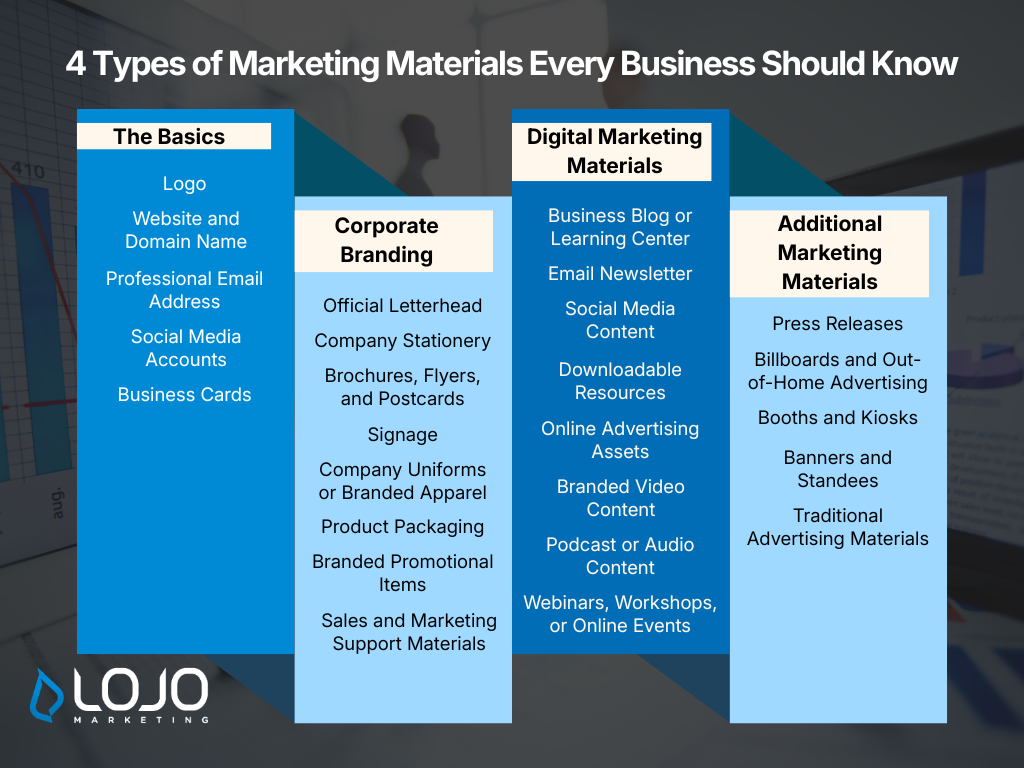
To make this easier, we can group common marketing materials into four categories:
The Basics. These are essential items that every single business needs. (We can’t quite think of any scenario where you won’t be needing any of these as a business or brand.)
Corporate Branding. These are some of the more traditional marketing materials used by businesses, but are still handy to this day—mostly printed collateral and other materials.
Your Digital Presence. These are essentially online marketing tools and materials, all particularly useful, especially if your business has a strong online component. These days, however, having a digital presence is more of a requirement and a necessity more than anything else.
Additional Marketing Materials. Not all businesses might be using these materials or marketing channels; these are more optional items, depending on what your regular activities are as a business or if your audience better resonates with these channels.
Let’s walk through each one.
Watch: Trust-Centered Messaging: Fixing Broken Marketing
Good marketing materials are not just about looking professional. They should help people feel clear, confident, and ready to take the next step. In this video, Community Connect session, we talk about how trust-centered messaging can help make your marketing feel more useful and more connected to the people you serve.
The Basics: Your "Must-Have" Marketing Materials
You’ll want to start with these core marketing materials. They form the foundation of your brand and will be used across your website, emails, social media, printed materials, and customer communications.
When these pieces are clear and consistent from the beginning, it becomes easier for people to recognize your business, contact you, remember you, and trust you.
1. Your Logo
Your logo is one of the most recognizable parts of your brand. It is important that you take the time to carefully develop a professional-quality logo because it will be incorporated throughout all other materials.
A good logo does not need to explain everything your business does. It can be simple or intricate, and may contain text or no text. The idea is that this image is a symbol of your brand and it uniquely represents you. It should be easily recognized and associated with your business, because if it is forgettable or too similar to a different logo, it will lose its symbolism for your brand.
It should also be flexible. Your logo may need to work on a large sign, a small social media profile image, a black-and-white document, or a branded shirt.
That is why it is worth taking the time to create a logo that feels polished and practical, not just attractive.
2. Your Website and Domain Name
Your website is your digital home base. Think of it as the ultimate collection of content that can help people get a feel for who you are and what is unique about your business.
When someone hears about your business, sees your ad, receives your card, or searches for your services, your website is often where they go next. So, a strong website should make it easy for someone to understand who you are, what you offer, where you serve, and how to contact you.
At a minimum, most small businesses need a homepage, an about page, service or product information, contact details, and a simple next step, such as calling, booking, or requesting a quote.
Your domain name also matters. Choosing the right domain name has an impact not just on your brand-building efforts, but on your SEO as well (so pick out a good one!). It should be easy to spell, easy to remember, and closely connected to your business name whenever possible.
Before you launch or refresh your website, ask someone outside your business to review it. If they can quickly understand what you do and how to take action, you are on the right track.
LOJO can help you create or improve a website that represents your brand clearly and gives visitors a smoother path to becoming customers.
3. Professional Email Addresses
Personal email addresses (such as those you may have made in your teenage/high school years) just won’t do; you should create a set of professional email addresses with your own domain name.
Email addresses from free providers (such as Hotmail, Yahoo!, Gmail, among others) won’t do either. A professional email address not only helps with your brand building, but it also goes a long way towards control, cohesiveness, and consumer trust.
Using an email address connected to your domain, such as [email protected], usually creates a stronger impression than using a personal email account or a free email provider for business communication.
It also gives your team more structure. As your business grows, you may need separate addresses for general inquiries, support, billing, sales, or specific team members.
Your email signature matters too. A simple branded signature with your name, role, company, phone number, website, and relevant links can make every email feel more complete and professional.
4. Social Media Accounts
Social media helps your business stay visible and connected. It gives people a way to see updates, learn more about your company, and get a feel for your personality and reliability.
That does not mean you need to be everywhere. Most small businesses are better off choosing one or two platforms they can manage consistently instead of trying to keep up with every channel.
The best platform depends on your audience and your type of business. A local service company may get strong value from Facebook and Google Business Profile updates, while a visual brand may benefit more from Instagram or Pinterest.
The most important thing is consistency. Your business name, contact information, website, profile images, and general messaging should match across your online presence.
Watch: Your New Front Door: The 2026 Blueprint for Google Business Profile Dominance
Social media is not the only place customers learn about your business. For many local searches, your Google Business Profile is one of the first places people see your hours, services, reviews, photos, updates, and contact information. It can shape whether someone trusts your business, reaches out, or keeps looking.
In this Community Connect session, we talk through how to make that first impression work harder by improving local visibility, building trust, and helping more searches turn into real inquiries.
5. Business Cards
Business cards are still useful, especially for networking, local partnerships, events, sales conversations, and in-person customer interactions.
A good business card gives someone the essentials: who you are, what business you represent, how to contact you, and where to learn more. It should be clean, readable, and aligned with your brand.
You can also include a QR code that leads to your website, booking page, portfolio, or contact form. This makes the card more useful without overcrowding the design.
Pro Tip: Keep a small stack of business cards with you, especially when attending local events or meeting potential partners. You can also ask nearby businesses, community spaces, or referral partners if they would be open to displaying a few cards where it makes sense. Just make sure the location fits your audience, and the relationship feels natural.
Corporate Branding Package
As your company grows, you may need additional branded materials to create a more polished and consistent experience.
A corporate branding package is especially helpful if you meet with clients, send documents, attend events, package products, or rely on printed materials as part of your sales process.
While many of these materials are in print, some clients would prefer the digital versions. This means you should have both available, allowing your customers more choices and better convenience.
6. Official Letterhead
As one of the most important print collaterals in any business, your letterhead carries with it the weight of your company, marking documents as official correspondence. It can be used for proposals, estimates, notices, agreements, printed letters, or PDF documents.
Even if most of your communication happens online, a clean, branded letterhead template can still be helpful. It gives important documents a more finished and credible appearance.
7. Company Stationery
Company stationery can include envelopes, folders, notepads, thank-you cards, shipping labels, or other printed items your business uses regularly.
Not every small business needs a full stationery set right away. But if you frequently send physical documents, mail products, attend meetings, or provide printed materials to customers, branded stationery can make the experience feel more intentional.
8. Brochures, Flyers, and Postcards
Brochures, flyers, and postcards are helpful when you need to explain your services, promote an offer, or leave information behind after a conversation.
They are especially useful for local promotions, community partnerships, trade shows, waiting rooms, direct mail, or sales meetings.
The key is to keep the message focused. A flyer does not need to say everything about your business. It should highlight the most important information and make the next step clear.
For example, if someone picks up your flyer, they should quickly understand what you offer, why it matters, and how to contact you.
9. Signage
Signage is especially important for brick-and-mortar businesses, service businesses, contractors, restaurants, retail shops, offices, and event-based brands.
A sign may be the first thing someone sees before they ever interact with your team. It should be easy to read, visually consistent, and appropriate for the space where it appears.
Signage can include storefront signs, window graphics, yard signs, vehicle graphics, event signs, indoor displays, or job site signs. Each one is a chance to reinforce your brand and make your business easier to recognize.
10. Company Uniforms or Branded Apparel
Branded apparel can help your team look professional and recognizable. This is especially useful for home service businesses, restaurants, retail teams, contractors, event staff, delivery teams, and other customer-facing roles.
Uniforms do not have to be overly formal. A branded shirt, jacket, hat, or name badge can create a more consistent impression and help customers quickly identify your team.
For businesses that work in customers’ homes or on job sites, this added recognition can also help build trust.
11. Product Packaging
If your business sells physical products, packaging is part of the customer experience.
Packaging helps people understand what they bought, how to use it, and what your brand stands for. It can also communicate important details like ingredients, instructions, care information, or product benefits.
You do not need elaborate packaging to make an impact. Even a branded sticker, thank-you card, insert, or simple label can make the experience feel more professional and memorable.
12. Branded Promotional Items
Branded promotional items can help keep your business top of mind when they are useful and relevant. This might include pens, magnets, stickers, tote bags, drinkware, notebooks, calendars, or small tools related to your industry.
The best promotional items are the ones your audience will actually use. A practical item with your branding can stay in front of a customer long after the first interaction.
13. Sales and Marketing Support Materials
Different industries may require specialized sales and marketing materials to explain their services, support sales conversations, or help customers make decisions.
This could include a service menu, pricing guide, portfolio, proposal template, case study, comparison sheet, customer onboarding guide, or one-page service summary.
A helpful way to know whether you need this type of material is to look at the questions your team answers repeatedly. If customers often ask the same thing, that may be a sign you need a clearer sales or marketing piece.
A well-designed guide or service overview can save your team time and help customers feel more confident before making a decision.
If your sales process feels harder than it should, LOJO can help you turn your services into clear, customer-friendly materials that support better conversations.
Digital Marketing Materials
Digital marketing materials are no longer optional for most businesses. According to the Pew Research Center, 96% of U.S. adults use the internet, which means your customers are likely going online to research products, compare services, read reviews, and decide who to contact next.
That includes local customers. People are not only searching for national brands or online stores. They are also looking for nearby services, local businesses, restaurants, shops, contractors, professionals, and experiences.
Your digital presence helps them find you, understand what you offer, and feel confident taking the next step.
14. Your Business Blog or Business Center
A business blog or learning center gives you a place to answer common questions, explain your expertise, and provide helpful guidance to your audience.
This is different from personal blogging. Business content should be focused on what your customers need to know. That might include how-to articles, service explanations, buying tips, maintenance advice, industry insights, or answers to common questions.
A helpful article can support your website, sales process, social media, email marketing, and long-term search visibility. It gives you a resource you can point people to again and again.
For an example of how this can look in practice, visit the LOJO Marketing Learning Center, where we share resources to help small businesses strengthen their marketing, improve their online presence, and support business growth.
15. Your Email Newsletter
Email marketing gives you a direct way to stay connected with leads, customers, past customers, and referral partners.
A newsletter can be used to share helpful tips, company updates, promotions, educational content, reminders, customer stories, or new services.
The key is to make your emails useful. If every message is only a sales pitch, people may tune it out. But if your emails help them solve problems, make better decisions, or stay informed, they are more likely to keep reading.

16. Social Media Content
With 5.79 billion social media user identities worldwide as of April 2026, social media remains an important part of how people discover, evaluate, and stay connected with businesses.
But that does not mean every business needs to be active on every platform—it does mean your business should have a clear, consistent presence on the channels your customers actually use.
Also, good social content does not always need to be complicated. You can share tips, answer common questions, highlight your team, show examples of your work, promote customer reviews, explain your services, or give people a behind-the-scenes look at your business.
A simple content plan can make this easier. Instead of wondering what to post each day, you can rotate through a few reliable content themes that support your goals.
17. Downloadable Resources
Downloadable resources are helpful tools your audience can save and use. Examples include checklists, guides, templates, worksheets, ebooks, or infographics.
They work best when they solve a specific problem. For example, a contractor might offer a project planning checklist, while a marketing company might offer a website audit guide.
Downloadable resources can also help with lead generation when someone provides their email address in exchange for the resource.
Check out LOJO Marketing’s Small Business Resources page, where we share practical guides and tools created for small business owners:
https://lojomarketing.com/free-small-business-resources
18. Online Advertising Assets
Advertising via search engines and social media has now taken the place of more traditional radio, TV, and print ads. Pay-per-click advertising is a marketing tool employed by many entrepreneurs and business owners to expand their client base and bring in a steady stream of new leads.
But paid ads need more than a budget. They need clear messaging, strong visuals, and a focused next step.
Your online advertising materials may include ad copy, graphics, short videos, landing pages, search ad headlines, lead forms, and follow-up messages. Each piece should work together so the customer knows what you offer, why it matters, and what to do next.
Paid ads often work best when they connect to a specific offer, service, or audience need.
Read: Is Advertising on Google Right for Your Business?
19. Branded Video Content
Video can help people understand your business quickly and personally. It is also one of the ways customers now prefer to learn about products and services.
According to Wyzowl’s 2026 video marketing report, 96% of people have watched an explainer video to learn more about a product or service, and 85% say they have been convinced to buy after watching a brand’s video.
You can use video to explain services, introduce your team, answer common questions, show your process, share customer stories, or demonstrate a product.
You do not always need a large production budget. In fact, HubSpot found that 63% of consumers prefer relatable and authentic videos over polished, high-production-value videos. Clear audio, good lighting, and a helpful message can go a long way, especially when your video answers a real question or helps customers understand what to do next.
20. Podcast or Audio Content
Podcasts have grown from a niche format into a mainstream way people learn, listen, and stay connected while going about their day.
Edison Research’s The Infinite Dial 2026 reports that U.S. podcast and online audio consumption have reached all-time highs, with 58% of Americans age 12 and older (167 million) listening to podcasts monthly.
The format works well because it fits into busy routines. People can listen while driving, walking, working, exercising, or handling tasks around the house.
Another benefit of podcast is that the content can often be repurposed. One episode can become short video clips, social media posts, email content, blog ideas, or quote graphics.
That does not mean all businesses should go start podcasting. But if your business has useful knowledge to share, audio content can help build trust over time. A podcast gives you room to answer common questions, talk through industry topics, interview customers or partners, and explain ideas that need more context than a short social media post allows.
21. Webinars, Workshops, or Online Events
Webinars, workshops, and online events can help you educate your audience and create a more personal connection. These formats work especially well when your product or service requires explanation, trust, or a longer decision-making process.
A financial advisor, consultant, software provider, home service company, wellness provider, or professional service business may use online events to answer questions, introduce a process, or help potential customers understand what to do next.
The best online events are focused and practical. People should leave with a clear understanding of the topic and a natural next step if they want more help.
Inside our Small Business Support Hub, we hold online discussions twice a month around topics that matter to business owners. It is a space to ask questions, learn from others, and get practical support. Join us and be part of a community built to support steady growth.

Additional Marketing Materials
Depending on your industry, audience, and growth goals, you’re going to need more specialized marketing materials such as the following:
22. Press Releases
A press release can help share newsworthy updates about your business, such as a new location, major partnership, event, award, community initiative, product launch, or company milestone.
Press releases work best when the announcement is genuinely relevant to a broader audience. They are not usually the first marketing material a small business needs, but they can be useful at the right moment.
23. Billboards and Out-of-Home Advertising
Out-of-home advertising includes billboards, posters, vehicle wraps, bus shelter ads, and other public-facing placements.
These materials are often used for brand awareness rather than immediate conversions. They can be beneficial if your business serves a specific local area and needs more visibility in that market.
If you use this type of advertising, make the message simple. People often only have a few seconds to understand it.
24. Booths and Kiosks
Just as your website gives people a place to learn about your business online, a branded booth or kiosk can give people a clear point of connection at an in-person event.
If your business attends trade shows, conferences, community events, fairs, or expos, your booth should do more than display your logo. It should help people quickly understand who you are, what you offer, and why it may be worth starting a conversation.
This does not need to be complicated. A clear display, simple printed materials, a QR code, and an easy way to collect contact information can make the experience more useful for both your team and your visitors.
The goal is not just to look polished during the event but to create a clear next step so interested people know how to stay connected after the event is over.
25. Banners and Standees
Banners and standees are useful for events, storefronts, promotions, trade shows, and temporary displays.
They can help promote an offer, announce a service, direct foot traffic, or make your space feel more branded.
Because people usually view banners quickly, keep the message short and easy to read. A banner should communicate one clear idea, not your entire business story.
26. Traditional Advertising Materials
Traditional advertising can still play a role in some marketing strategies. Depending on your audience, that might mean direct mail, local print ads, radio spots, TV commercials, or magazine placements.
These channels are most effective when they are chosen intentionally based on your audience, location, budget, and goals.
For many small businesses, traditional advertising works best when paired with digital tools. A QR code, landing page, tracking phone number, or follow-up email campaign can help connect offline attention to measurable action.

How To Decide What You Need First
You do not need to create every marketing material at the same time. In fact, trying to do everything at once can lead to scattered messaging and unnecessary spending.
Start with the materials that support your most important customer interactions.
If people are finding you online but not contacting you, your website or calls-to-action may need attention. If your team is having the same sales conversation over and over, you may need a clearer service guide or proposal template. If customers are not sure what makes you different, your branding and messaging may need to be refined.
For most small businesses, the strongest starting point is a clear logo, website, professional email, consistent social profiles, basic printed materials, and a simple follow-up process. From there, you can add more advanced materials as your business grows.
When your materials are clear, consistent, and connected, they become easier to use and more helpful for the people you are trying to reach.

A Final Word About Your Marketing Materials
Your marketing materials should make it easier for people to understand your business, trust what you offer, and take the next step.
But you do not need to build every piece at once. You can start small with the pieces that support how customers already find, evaluate, and contact your business. Then build from there as your needs become clearer.
The most important thing is consistency. Your website, social media, printed materials, emails, ads, and sales pieces should all feel like they belong to the same business and point people toward a clear next step.
If your current materials feel scattered, outdated, or hard to use, it may be time to step back and look at the bigger picture. LOJO Marketing helps small businesses create connected and strong marketing materials across branding, websites, digital marketing, and customer communication. Contact us to talk through what you have now, what needs attention, and what will help your business move forward.

Built for Growth. Backed by 25 Years of Trust.
For over two decades, LOJO has been a trusted partner to hundreds of businesses just like yours. Whether working directly with owners, managers, teams, or boards of directors, our goal remains the same: to be a reliable and results-driven asset to your business.
Over the years, we’ve carefully built a team of experts—each selected for their unique skills, strengths, and personalities. Our clients choose LOJO because they know we genuinely care about their success.
And after 25 years of helping businesses grow, we’re more committed than ever.

Built for Growth. Backed by 25 Years of Trust.
For over two decades, LOJO has been a trusted partner to hundreds of businesses just like yours. Whether working directly with owners, managers, teams, or boards of directors, our goal remains the same: to be a reliable and results-driven asset to your business.
Over the years, we’ve carefully built a team of experts—each selected for their unique skills, strengths, and personalities. Our clients choose LOJO because they know we genuinely care about their success.
And after 25 years of helping businesses grow, we’re more committed than ever.


Matthew Rogers, President
iProspect Check
After spending several months reviewing multiple proposals from several different companies we engaged LOJO to develop a new website that represents our company effectively. We worked initially with Stephen Platte who helped create the scope of the project. Stephen was knowledgeable and always followed up with me on time and as promised.
He "closed the deal" for LOJO with his professionalism, service orientation and easy going approach. Once we signed the contract we were introduced to Jay Kelly who would be the creative lead for LOJO. This was the most challenging part of the project for my company, as there was no shortage of ideas from our side. Jay managed the project flawlessly, and once we had all agreed to the design, Jay introduced us to Eric.
Eric Lay is one of the founders of LOJO. Eric took the design we had developed and brought it to life. We delivered content as quickly as he requested it. Eric kept the project on task and we responded by exceeding every deadline for content. In turn, once provided, literally not a day went by that Eric didn't add the content and take the next step. In just a few weeks we launched our new website. Eric is a pleasure to work with.
His positive attitude and consultative approach really enhanced the experience and made a big difference for us in the outcome of our project. We would welcome you to visit our website to take a look at the quality work of LOJO. We are very pleased with LOJO and look forward to working with them in the future as we pursue an aggressive SEO strategy."
After spending several months reviewing multiple proposals from several different companies we engaged LOJO to develop a new website that represents our company effectively. We worked initially with Stephen Platte who helped create the scope of the project. Stephen was knowledgeable and always followed up with me on time and as promised.
He "closed the deal" for LOJO with his professionalism, service orientation and easy going approach. Once we signed the contract we were introduced to Jay Kelly who would be the creative lead for LOJO. This was the most challenging part of the project for my company, as there was no shortage of ideas from our side. Jay managed the project flawlessly, and once we had all agreed to the design, Jay introduced us to Eric.
Eric Lay is one of the founders of LOJO. Eric took the design we had developed and brought it to life. We delivered content as quickly as he requested it. Eric kept the project on task and we responded by exceeding every deadline for content. In turn, once provided, literally not a day went by that Eric didn't add the content and take the next step. In just a few weeks we launched our new website. Eric is a pleasure to work with.
His positive attitude and consultative approach really enhanced the experience and made a big difference for us in the outcome of our project. We would welcome you to visit our website to take a look at the quality work of LOJO. We are very pleased with LOJO and look forward to working with them in the future as we pursue an aggressive SEO strategy."
Matthew Rogers, President
iProspect Check
The team at LOJO were wonderful to work with. They are well organized and very patient as we worked through our marketing strategy and developed a well thought out and clear action plan at a reasonable price. We will definitely be back for our future campaign needs."

Jon Crosby, Founder
Dazil