

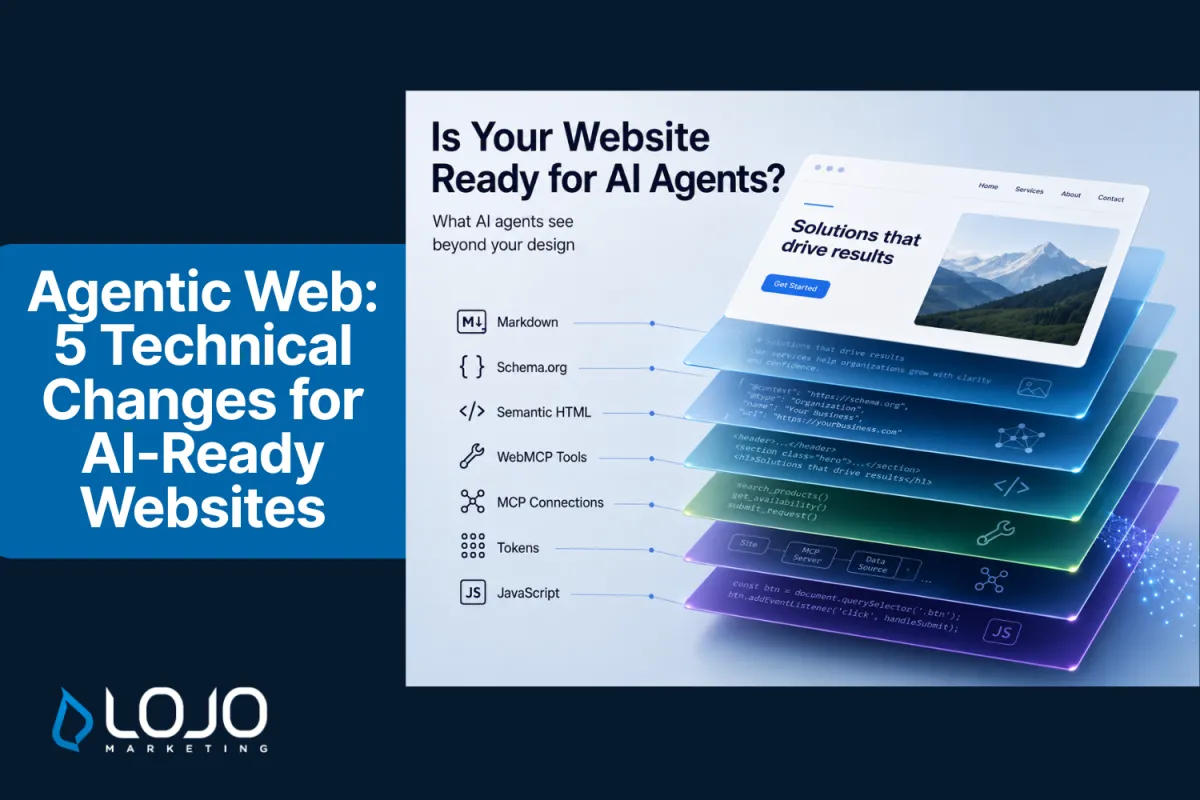
Agentic Web: 5 Technical Changes for AI-Ready Websites
For decades, websites have been designed for two main audiences: human visitors and search engine crawlers.
User experience, or UX, focused on helping people navigate and use a website. Search engine optimization, or SEO, helped platforms such as Google crawl, interpret, and rank its content.
Now, a third audience is becoming more important: AI agents.
Unlike traditional crawlers that primarily discover and index pages, AI agents can work toward a broader goal. They may gather information, compare options, interact with online tools, and complete parts of a task on a user’s behalf.
For example, someone could ask an AI tool to compare local contractors, identify which companies serve their area, review the services each one offers, and recommend who to contact. The agent may evaluate several websites before the person visits any of them.
The broader shift toward non-human website traffic is already clear. According to Imperva’s 2025 Bad Bot Report, automated systems accounted for more than 51% of web traffic. That figure includes search crawlers, monitoring tools, scrapers, security bots, malicious bots, and other automated systems—not only AI agents. Still, AI agents are becoming a more capable category of machine visitor because they can retrieve information, interact with interfaces, and execute workflows.
This change introduces a new technical consideration for website owners and developers. A website may need to do more than display information clearly. Its content, structure, and functions may also need to be understood and used by machines.
Some teams refer to this as Agent Experience, or AX: the technical experience a website provides to an AI system attempting to understand or interact with it.
Many of the standards involved are still developing. Businesses do not need to implement every new protocol immediately, but anyone planning a website rebuild, new application, booking system, ecommerce experience, or AI integration should understand where the technology is heading.
Keep reading for five technical shifts that may shape how websites are discovered, interpreted, and used by AI agents.

Agentic Web: 5 Technical Changes for AI-Ready Websites
5 Technical Changes Shaping the Agentic Web
1. Token Weight Is Becoming Part of Website Efficiency
Why Markdown Is Receiving More Attention
What Website Owners Should Review
2. WebMCP Could Give AI Agents a "Remote Control"
Declarative and Imperative WebMCP
Security and User Control Matter
3. NLWeb Could Make Websites Directly Queryable
Schema.org Becomes a Grounding Layer
NLWeb Is a Direction, Not a Finished Requirement
4. MCP Connects Agents to Data Beyond the Website
MCP Has Moved Beyond an Early Experiment
Context Can Become a Problem of Its Own
Governance Comes Before Automation
5. JavaScript Can Still Create Machine-Readability Gaps
From Information Retrieval to Action
5 Technical Changes Shaping the Agentic Web

1. Token Weight Is Becoming Part of Website Efficiency
Website performance has traditionally been measured through factors such as file size, page speed, and loading time.
The agentic era introduces another consideration: token weight.
Tokens are the small units of text that an AI model processes. A token may be a complete word, part of a word, punctuation, or a piece of code. Every page, instruction, tool description, and result an agent receives consumes part of its available context window.
A context window is the amount of information an AI model can process during one interaction.
When an agent retrieves a standard webpage, it may receive much more than the written content a person sees. The underlying HTML can include:
Navigation menus
Styling instructions
Repeated headers and footers
Tracking scripts
Form code
Layout containers
Accessibility attributes
Interactive components
Other technical elements
Much of that code is necessary for the human experience. But it can also create additional material that an AI system must filter before reaching the useful information.
Why Markdown Is Receiving More Attention
Markdown is a lightweight text format that uses simple characters to define headings, lists, links, and other elements.
For an AI system, Markdown can provide the meaning and structure of a page without much of the code used to control its visual presentation.
Cloudflare demonstrated this difference using one of its own articles. The page required approximately 16,180 tokens when processed as HTML and 3,150 tokens after conversion to Markdown—an 80% reduction for that specific page.
“Markdown has quickly become the lingua franca for agents and AI systems as a whole. The format's explicit structure makes it ideal for AI processing, ultimately resulting in better results while minimizing token waste.” — Cloudflare
That example does not mean every website will achieve the same reduction. It also does not establish token weight as a search ranking factor.
The practical concern is processing efficiency. A cleaner response can help an agent:
Find the relevant information faster
Fit more useful content inside its context window
Reduce the processing required to interpret the page
Avoid confusing page content with navigation or interface elements
Preserve the intended hierarchy of the information
What Website Owners Should Review
Most businesses do not need to publish a separate Markdown version of every page. Google says websites do not need new machine-readable files, AI text files, or special structured data to appear in AI Overviews or AI Mode. Existing SEO and technical requirements continue to apply.
The stronger starting point is clean semantic structure, which includes:
Using one clear primary heading
Organizing sections with descriptive subheadings
Writing focused paragraphs
Using lists for information that belongs in a list
Removing unnecessary duplicated content
Keeping important details in readable text
Using HTML elements according to their intended purpose
Separating page content from navigation and interface controls
Businesses with advanced technical requirements may also evaluate content negotiation, Markdown delivery, or structured content APIs. These are additional layers, not replacements for a well-organized website.

2. WebMCP Could Give AI Agents a "Remote Control"
Navigating a traditional website is, for an AI agent, like attempting to operate a television without a remote. The agent can “see” the screen via visual processing, but it lacks a structured way to interact with the underlying logic.
A person can often infer that a calendar icon opens a date picker or that a button labeled “Continue” leads to the next step. An agent must interpret those elements from the page’s code, accessibility structure, visual appearance, or surrounding text.
Small changes to a website’s design can also disrupt an agent that relies on the location or appearance of an element.
The Web Model Context Protocol (WebMCP), a browser-native standard co-developed by Google and Microsoft, solves this by giving the agent the “remote control.”
Instead of forcing an agent to infer what every button or field does, WebMCP allows a website to describe certain functions as tools. The agent can then select and use the tool based on its defined purpose.
For example, a website could expose tools that allow an agent to:
Submit a support request
Search available appointments
Filter products
Add an item to a cart
Calculate an estimate
Retrieve an order status
Begin a reservation
The agent receives a structured description of the available action, the information it requires, and the type of response it returns.
Declarative and Imperative WebMCP
The current WebMCP proposal provides two main implementation paths.
The Declarative API is designed for standard HTML forms. Developers can add annotations that identify the form as a tool and explain what it does. Existing fields become the tool’s parameters.
For example, a contact form could be identified as a tool for creating a service request. The agent would know which fields require a first name, last name, email address, service type, or message. The form would remain visible to the user while the agent fills it in.
The Imperative API is intended for functions controlled through JavaScript. It can support more complex actions involving application logic, changing page states, calculators, searches, or multi-step workflows.
WebMCP Is Still Experimental
As of July 2026, WebMCP is not a universal website standard.
Chrome opened an origin trial for WebMCP in Chrome 149. Origin trials allow developers to test experimental browser features on live websites and provide feedback before a standard is finalized or broadly adopted.
Businesses should therefore avoid treating WebMCP as a requirement for every website, while noting that its direction is still important, as it suggests that websites may increasingly need structured ways to explain not only what their content means, but also what actions their interfaces can perform.
Security and User Control Matter
Giving an AI agent access to website functions introduces risks.
A tool that reads product information is different from one that changes an account, submits private information, places an order, or processes a payment.
Current WebMCP guidance recommends limiting tools to trusted origins, carefully controlling read-and-write access, keeping descriptions focused, and preserving user visibility and control. Questions around consent and agent-initiated actions are still being developed.
Businesses exploring this technology should define:
Which actions an agent may perform
Which actions require confirmation
What data the agent may access
How the user’s identity will be verified
How actions will be logged
What happens when a tool fails
How access can be withdrawn
The immediate priority is simpler: build forms and workflows that are clearly labeled, semantically structured, and reliable. Those improvements help people now and create a stronger foundation for future agent tools.

3. NLWeb Could Make Websites Directly Queryable
Search engines traditionally help users find pages that may contain an answer.
A conversational web interface takes a different approach as it allows the user or an agent to ask a question directly and receive an answer based on the website’s information.
NLWeb, or Natural Language Web, is a Microsoft-led open project focused on helping websites provide that type of conversational access.
An NLWeb implementation could allow someone to ask a website questions such as:
Which services are available in my area?
Which product supports this requirement?
What appointments are available next week?
Which plan includes multiple locations?
What is the return policy for this item?
Which articles address this specific problem?
Rather than asking an AI system to interpret every page independently, the website could offer a natural-language endpoint built around its own content and data.
Schema.org Becomes a Grounding Layer
NLWeb uses existing structured formats, including Schema.org and RSS, to help identify and organize information.
Schema.org provides a shared vocabulary for describing entities and relationships on the web. It can identify that a piece of information represents a business, product, person, article, event, location, offer, review, or other defined type.
This can give a conversational system a more reliable foundation for answering questions.
For example, visible text might state that a business serves Middle Tennessee. Supporting structured data could identify:
The organization
Its official name
Its primary website
Its service or product
Its location
Its contact information
Related pages or entities
In this ecosystem, Schema.org moves from being a passive SEO tool to a “grounding source” for conversational answers. Instead of a buyer being directed to a list of “10 blue links,” NLWeb allows an agent to query your site directly to answer complex questions like “Which of these plans supports SOC2 compliance for a team of 50?”
If an agent cannot “talk” to your site through these standardized layers, your brand’s unique value propositions become invisible to users researching through Gemini or ChatGPT.
NLWeb Is a Direction, Not a Finished Requirement
The NLWeb project describes itself as a collection of open protocols and reference implementations. Its published code is intended to demonstrate possible approaches rather than serve as the final solution every website must use.
You do not need to add an NLWeb endpoint simply to remain visible online.
It is also important not to confuse NLWeb with current Google Search requirements. Google says there is no special Schema.org markup required for its AI features. Structured data should continue to match the visible information on the page and be used where it supports existing search features.
So the practical lesson is broader: websites with clear information models will be easier to adapt to conversational systems than websites built from disconnected pages, vague descriptions, and inconsistent business data.
What to Review Now
Review whether your structured data accurately represents:
The business or organization
Services and products
Locations and service areas
Articles and authors
Events
Offers
Contact information
Frequently asked questions, where appropriate
Other important entities specific to the business
The structured data should agree with what visitors can see. Incorrect, hidden, or exaggerated markup can create more confusion rather than less.
4. MCP Connects Agents to Data Beyond the Website
While WebMCP focuses on actions within a webpage or browser experience, the Model Context Protocol, commonly called MCP, addresses a broader problem: connecting AI applications to external systems, tools, and data.
Anthropic introduced MCP in 2024 as an open standard for creating two-way connections between AI applications and systems such as databases, business platforms, development tools, and content repositories.
What MCP Could Connect
MCP is often compared to a universal connection port. Without a shared protocol, developers may need to create separate integrations for every combination of AI application and business system. One connection may be needed for an AI assistant to access a CRM, another for a calendar, another for a document platform, and another for inventory.
An MCP server can make approved data or tools available. An MCP client, such as an AI application, can connect to that server and use what it provides.
Depending on how it is configured, MCP can connect an agent to:
CRM records
Calendars
Inventory systems
Product databases
Internal documents
Project management platforms
Customer support systems
Reporting tools
File storage
Custom business applications
Consider a service business that uses separate systems for leads, appointments, estimates, and project records. With properly governed connections, an agent could potentially retrieve a lead’s information from the CRM, check scheduling availability, prepare a project summary, and create a follow-up task without relying on someone to copy information between platforms.
MCP Has Moved Beyond an Early Experiment
MCP has developed more quickly than many other agentic web protocols.
By December 2025, Anthropic reported more than 10,000 active public MCP servers and adoption across platforms including ChatGPT, Gemini, Microsoft Copilot, Visual Studio Code, and Cursor. MCP was also donated to the Agentic AI Foundation under the Linux Foundation to support vendor-neutral governance.
Strategic innovations like AWS Context extend this by creating an organizational knowledge graph. These systems are identity-aware and governed by default, inheriting IAM and Lake Formation permissions to ensure agents only access data they are authorized to see. Crucially, these graphs “learn” from usage patterns, identifying “join paths” and resolving “schema ambiguities” over time to make the entire organizational context layer more intelligent.
Context Can Become a Problem of Its Own
Connecting an agent to more tools does not always make it more effective.
Every available tool must be described to the model. Tool instructions and returned data consume tokens and occupy part of the context window. If an agent is connected to hundreds or thousands of tools, it may have difficulty selecting the correct one or processing all the available information efficiently.
Anthropic has documented cases in which large tool definitions and intermediate results can increase token use, latency, and the likelihood of errors.
This is another reason to avoid connecting everything simply because the connection is possible.
Businesses should provide agents with the smallest set of tools and data needed to complete the approved task.
Governance Comes Before Automation
Not every available MCP connection is necessarily secure, reliable, or appropriate for business use. The protocol standardizes how systems connect but does not remove the need for careful access control.
Before connecting an AI agent to internal systems, you should define:
Who is allowed to use the connection
What information the agent may read
Which records it may create or change
Which actions require human approval
How customer and employee information will be protected
How activity will be logged
How incorrect actions will be reversed
What happens when a connected system is unavailable
Bring Your Customer Journey Into One Place

AI connections work better when your business information is organized. GrowthGenie360 helps bring your contacts, conversations, appointments, pipelines, forms, and follow-up into one platform. That gives your team a clear view of each customer and reduces the gaps created by disconnected systems.
Build a stronger operational foundation now—and make it easier to adapt as AI tools continue to develop. Explore GrowthGenie360 today.
5. JavaScript Can Still Create Machine-Readability Gaps
A critical technical risk for digital architects is the JavaScript blind spot. Many modern websites depend on JavaScript to load content, control navigation, display interactive tools, and manage application logic.
Now most AI crawlers, including those powering ChatGPT and Claude, cannot execute JavaScript. If your core content or conversion tools are built with React, Vue, or other client-side rendering frameworks, they appear as “blank pages” to AI agents. High-quality content is worthless if it isn't rendered in the DOM as static HTML.
To remain visible, JavaScript-heavy sites must utilize dynamic rendering or prerendering to serve agents a machine-readable snapshot while maintaining the interactive experience for humans.
From Information Retrieval to Action
The first phase of online search focused on retrieval: helping users find pages and information. And the rise of the agentic web represents a paradigm shift from information retrieval to an action-oriented framework.
AI systems may increasingly move from answering questions to completing tasks through websites, browser tools, APIs, and connected business systems.
That shift will depend on several layers working together:
Clear and efficient content
Accurate structured data
Reliable rendering
Controlled crawler access
Structured website tools
Secure connections to business data
User identity and consent
Logging and human oversight
Not every business needs WebMCP, NLWeb, Markdown delivery, or a custom MCP server today.
But the underlying principles already matter. In this environment, “Context is the data lake for AI agents.”
The winners of this era will be those who clearly define information, return meaningful HTML, use semantic structure, maintain accurate structured data, and provide dependable workflows that are easier for people, search engines, and future AI agents to use.

Start With an Agent-Readiness Audit
Do not begin by installing every new protocol but by reviewing the technical foundation that these systems depend on.
An agent-readiness audit should examine:
Content availability: Is important information available as clear text?
Semantic structure: Do the page elements correctly describe their purpose?
Structured data: Does the markup accurately represent the visible content?
Rendering: Can essential content be accessed without a fragile JavaScript sequence?
Crawler controls: Are legitimate systems being blocked unintentionally?
Actions: Are forms, searches, bookings, and other workflows clearly defined?
Data access: Are connected systems protected by appropriate permissions and approval steps?
Consistency: Do the website, business listings, CRM, and other systems agree?
Is Your Website Ready for the Agentic Web?
AI agents are not replacing human visitors—they are becoming another layer between businesses and the people researching them.
That creates a new question for website owners:
Can your website’s information and functions still be understood when an AI system is working on the customer’s behalf?