TO LEARN IS TO GROW
Learning Center
We do our research and publish our results. Should probably call this the Growing Center.

Zero-Click Searches Explained: What Businesses Should Do Now
Search is changing, and for a lot of small business owners, it’s starting to show up as one simple problem:
Your website traffic isn’t what it used to be.
But this isn’t just about traffic.
The way people search, find answers, and decide who to work with has shifted. And if your strategy is still built around how search worked a few years ago, it’s going to feel like things are slipping—even if you’re doing the right things.
Let’s walk through what’s actually happening, why it matters, and how to adjust without overcomplicating your marketing. Scroll down to learn more.
This session was part of our Community Connect, a live series we host for business owners inside our Facebook community.
Each session is focused on breaking down what’s happening across business, marketing, and the broader industry—along with practical ways to respond. Some sessions are more structured, like a presentation. Others are more conversational, like sitting down and talking through real scenarios.
The format can change, but the goal stays the same:
help you make sense of what’s changing and give you a clear way to move forward.
We run these sessions twice a month, live inside the community.
If you want to join live and be part of future sessions, you can join here:
https://www.facebook.com/groups/ussmallbusinesssupporthub
What's Changing in Search
If your website traffic has been going down, there’s a real reason behind it.
Search engines are no longer just helping people find information—they’re delivering the answer directly.
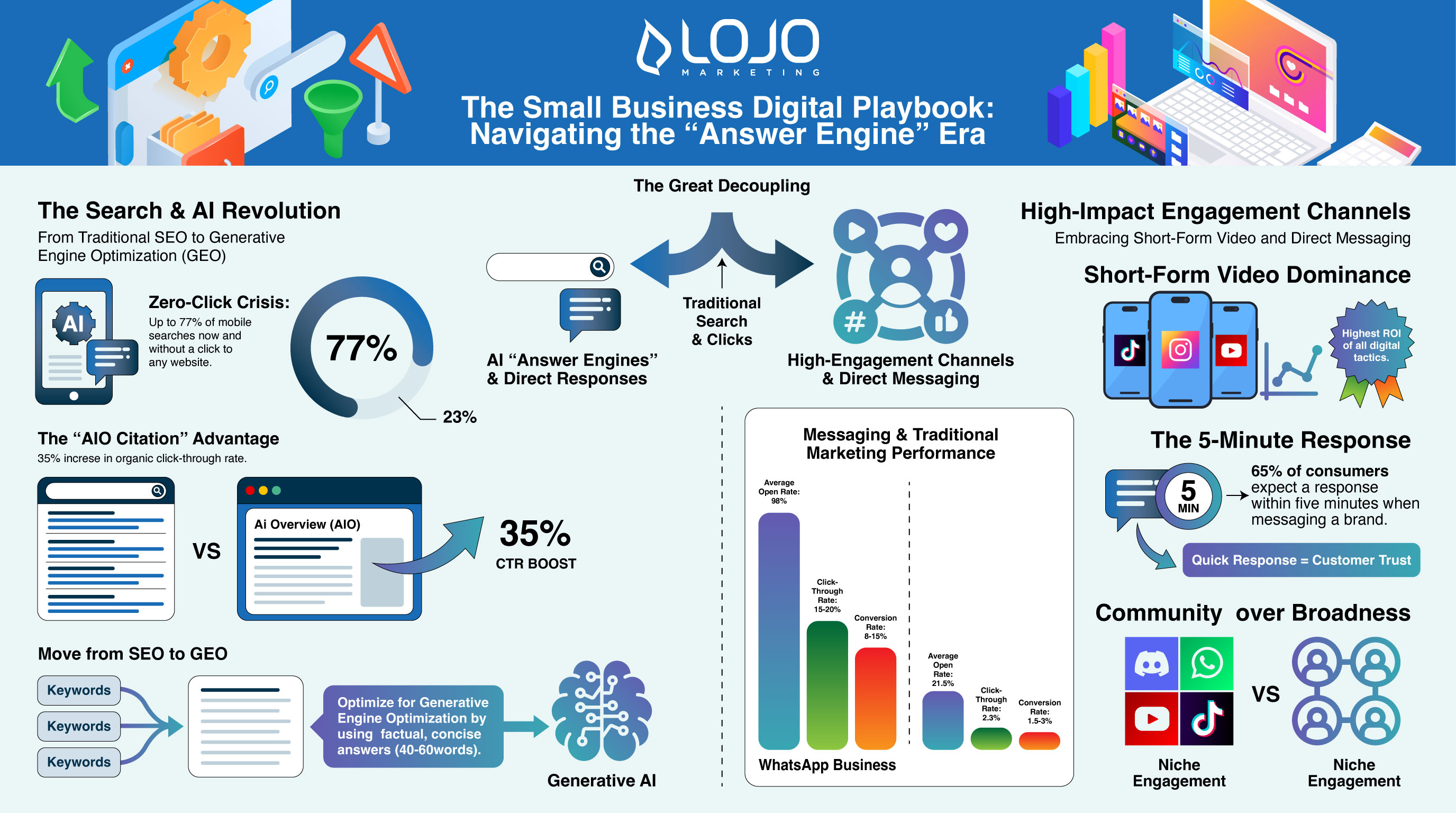
When someone types a question today, they’re often met with an AI-generated summary, a featured snippet, or a direct response at the top of the page. In many cases, they get what they need without ever clicking through to a website.
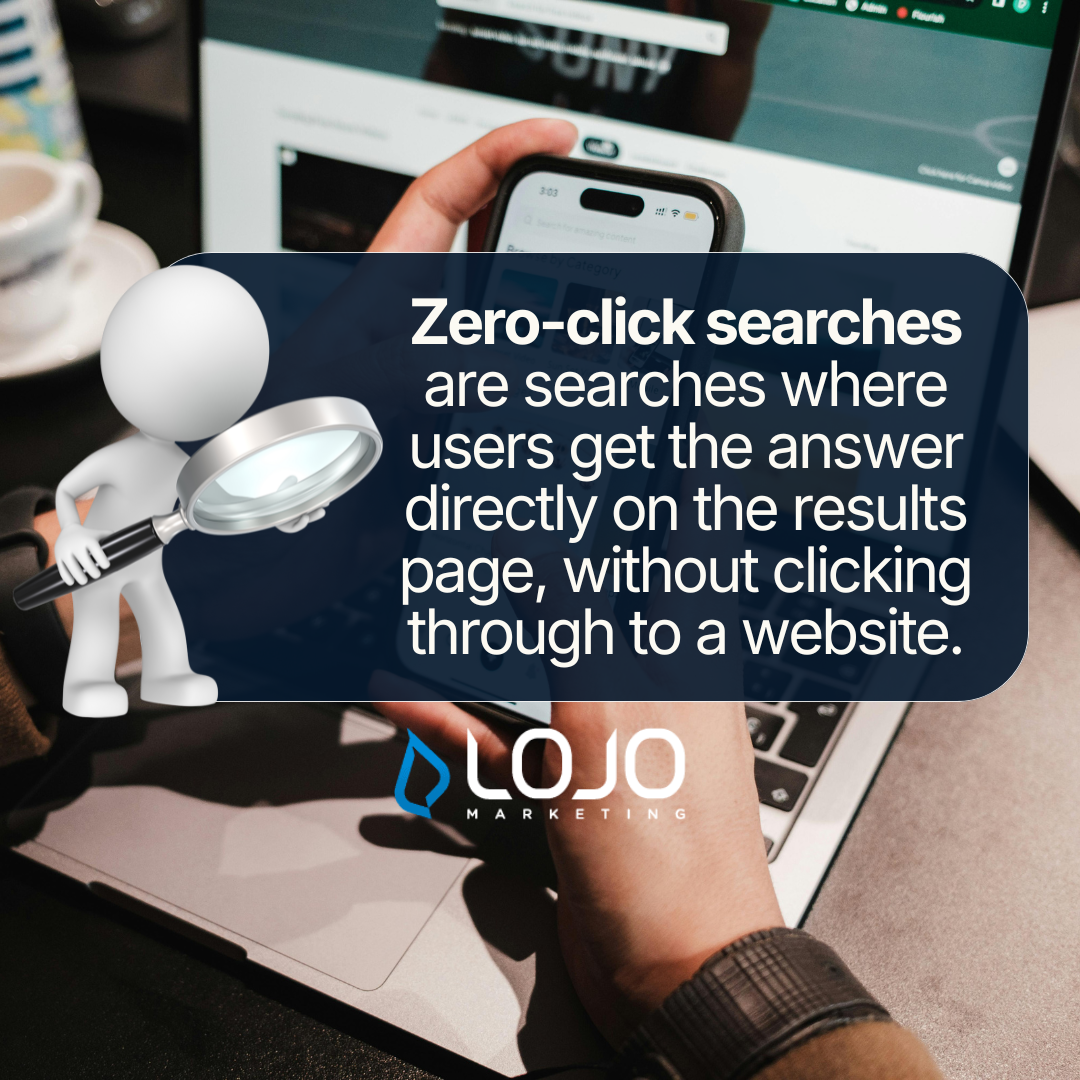
These are known as zero-click searches. And they now make up a significant portion of how people interact with search, especially on mobile devices.
For businesses that relied on content and SEO to bring people to their website, this creates a noticeable shift. The effort to create helpful content still matters, but the way that content is used has changed.
The Bigger Shift Behind It
This change is part of a broader pattern.
More people are searching than ever before. Questions are increasing. Curiosity is increasing. But at the same time, website traffic is declining.
That gap is what’s often referred to as the “great decoupling.”
Search platforms are still pulling from websites to generate answers. But instead of sending users to those sources, they’re keeping users within their own environment.
So even if your content is contributing to the answer, you may not see the click.
For many small business owners, this can feel like something is broken. But in reality, the system itself has changed.
Why This Is the New Normal
From the user’s perspective, this shift makes sense.
If someone is looking for a quick answer, they don’t want to open multiple tabs or read through long pages to find it. They want clarity, and they want it immediately.
Search engines are adapting to that expectation.
And as answers become easier to access, people search more frequently. The number of searches goes up, but the number of clicks does not.
This is not a temporary adjustment. It’s a new baseline for how search works.
How Search Now Responds To Intent
One of the most important changes is how search engines adjust based on what the user is trying to do.
\When someone is simply looking for information, the results prioritize direct answers. AI summaries and featured snippets appear at the top, often removing the need to click on any website.
For example, someone might search: “what is the best driveway surface”
Instead of clicking through multiple articles, they’re shown a summarized answer right away—comparing options like concrete and asphalt—pulled from different sources.
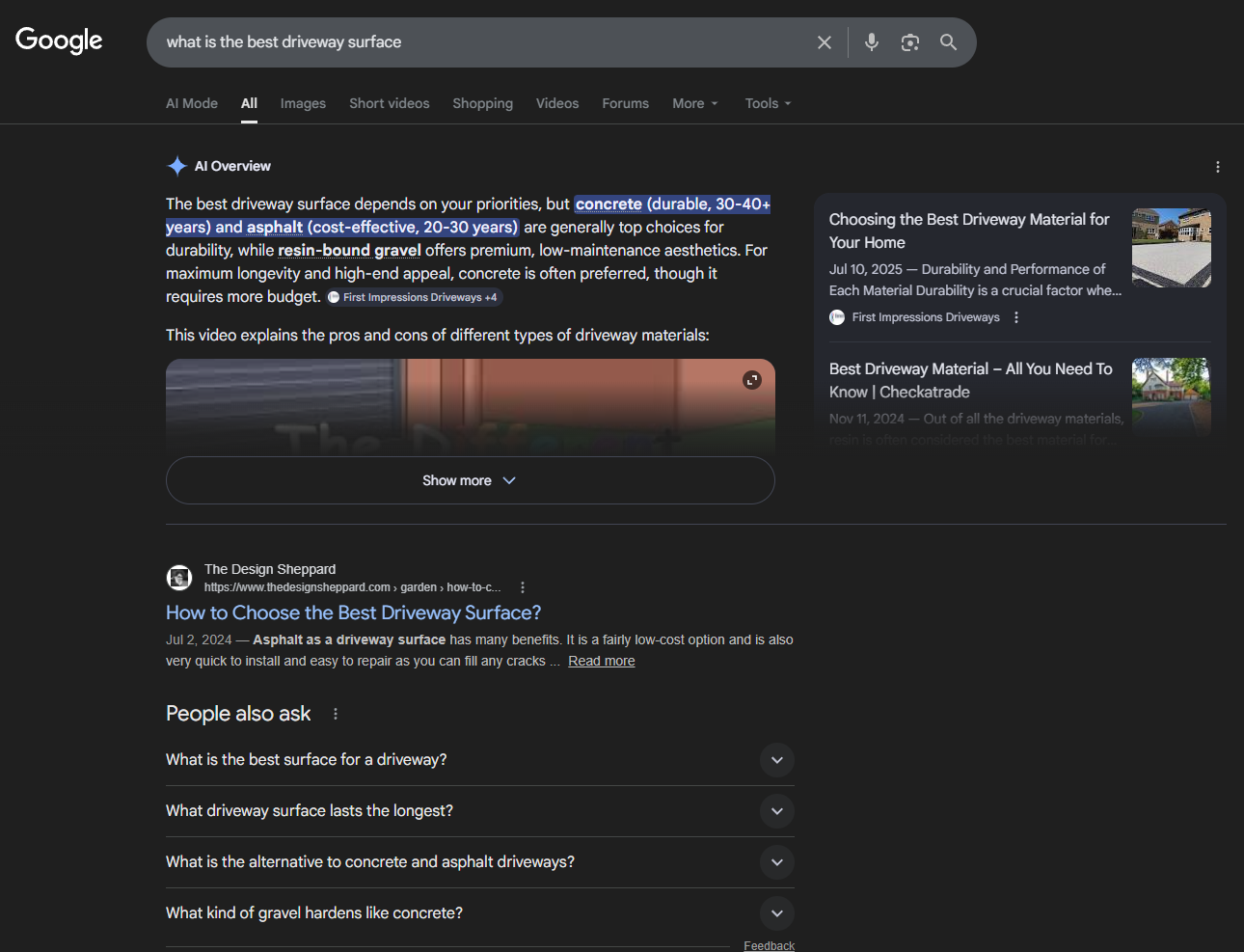
This is an informational search. The goal is to get a quick answer, so Google shows AI summaries and direct explanations, often without needing to click.
When the intent shifts toward exploring options—such as looking for services or providers—the results change. Paid ads and local listings become more prominent, pushing organic results further down the page.
So if that same person now searches: “driveway contractors in roseville ca,” the top of the page is no longer educational content. It’s ads, Google Maps listings, and business profiles. Even if your website ranks well organically, it may not appear until much further down.
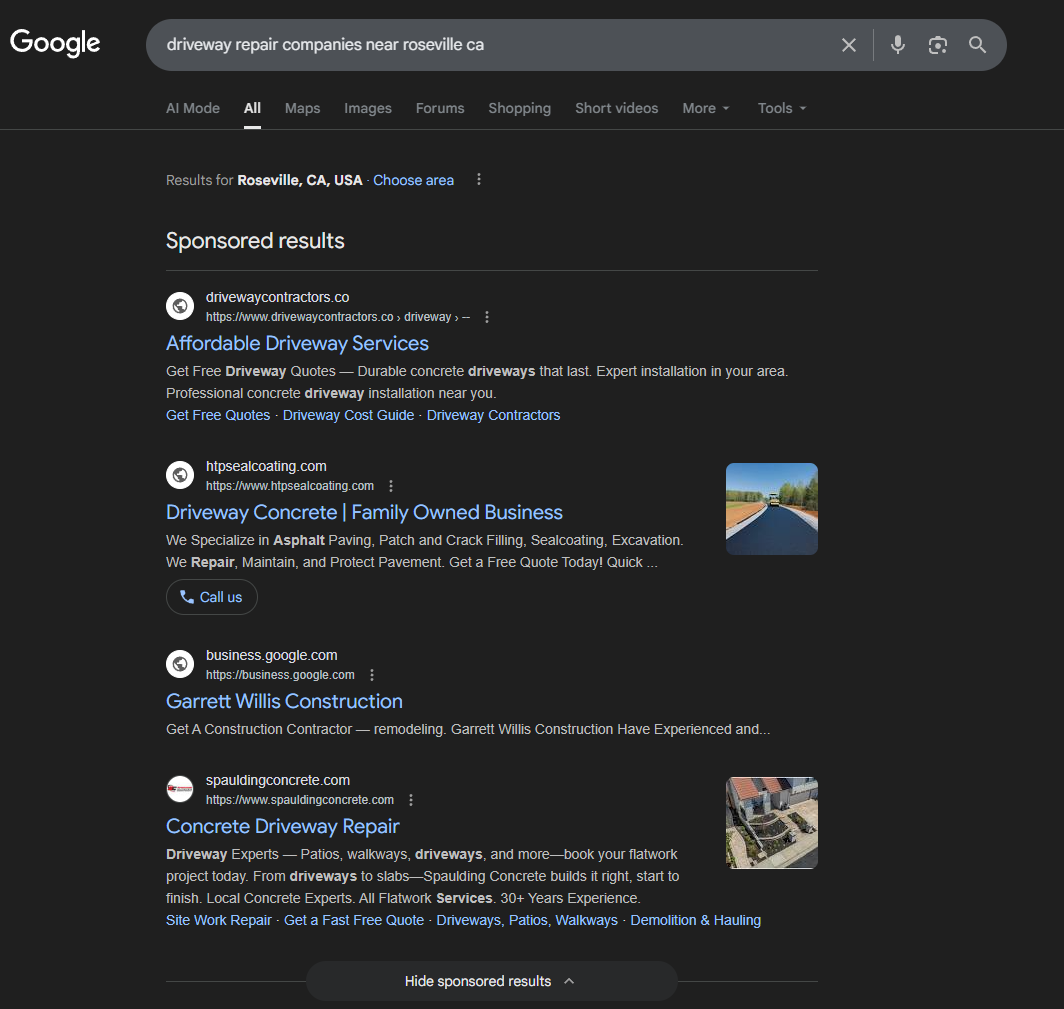
This is a discovery search. The goal is to find options, so Google prioritizes ads, maps, and local business listings over traditional website results.
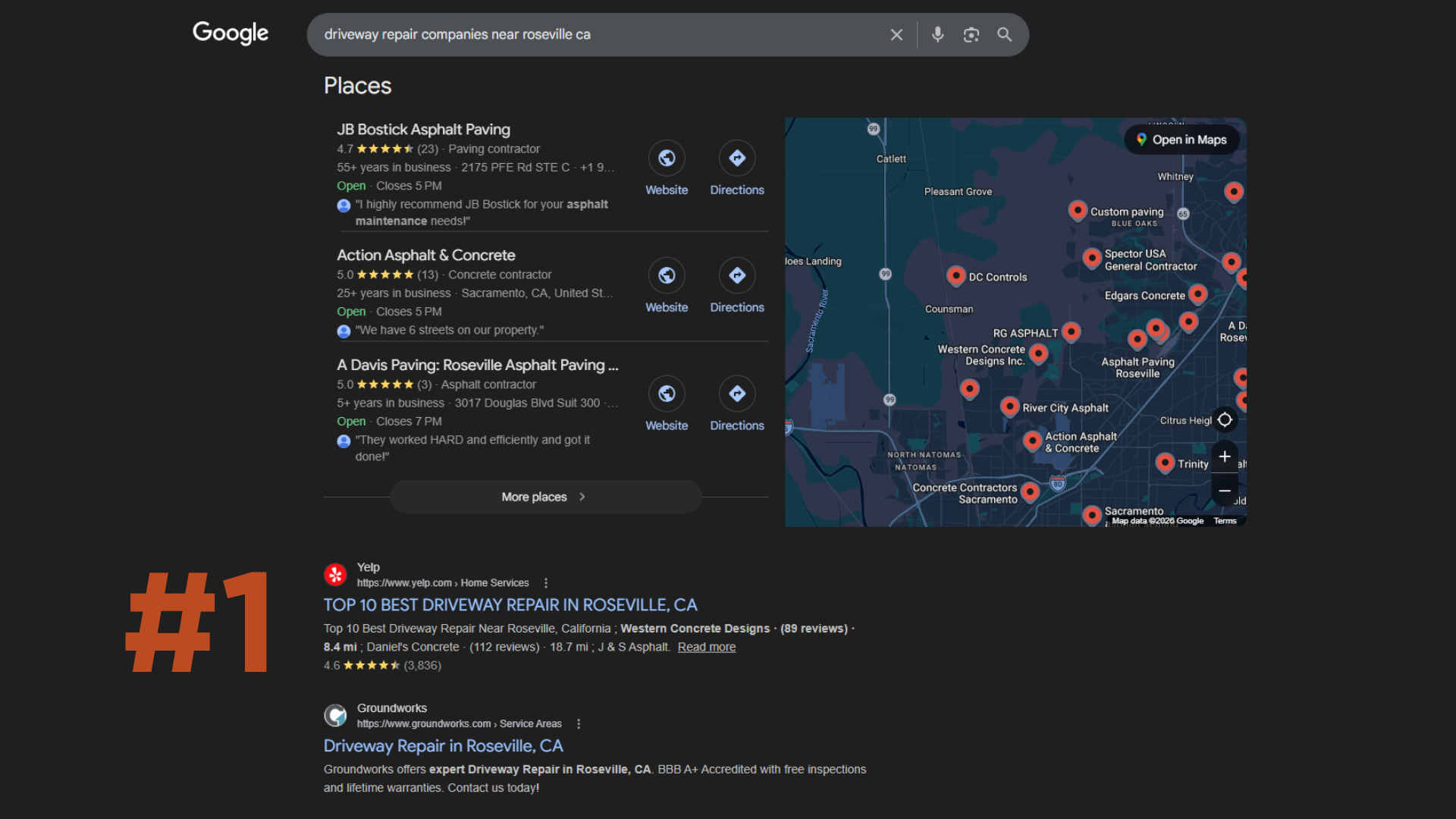
Even a #1 organic result may not appear at the top of the page.
This is why ranking alone doesn’t guarantee visibility. Where you show up depends on what the person is trying to do, not just how well your website is optimized.
Rethinking What Matters
Because of these changes, it’s important to rethink what you’re measuring.
Traffic alone doesn’t give you a complete picture anymore. A decrease in visitors doesn’t automatically mean a decrease in performance.
What matters more now is intent and outcome.
Are people searching specifically for your business?
Are they reaching out?
Are those conversations turning into real opportunities?
Branded searches, calls, messages, and form submissions reflect a higher level of interest. These are the signals that show whether your marketing is actually working.
In many cases, fewer but more qualified interactions are more valuable than a high volume of low-intent traffic.
Making Your Content Work in This Environment
If search engines are answering questions directly, your role shifts from attracting clicks to shaping those answers.
That starts with clarity.
Your content should directly answer real questions in a clear and concise way. A strong approach is to begin with a short explanation that could stand on its own, then expand with additional detail and context. This makes it easier not just for people to understand, but for search engines to extract and use your content when generating answers.
Structure also plays a role. Search engines and AI systems rely on clear signals to understand what your content is about. Using structured data helps define your business, your services, and your expertise in a way that’s easier for machines to interpret. Instead of guessing, they can confidently identify what you do and when your content is relevant.
At the same time, credibility matters more than ever. Google has long emphasized signals of experience, expertise, authority, and trust—often referred to as E-E-A-T. While users may not see this directly, it influences which content gets surfaced and relied on.
In practice, this means your content should reflect real-world experience, not just general information. It should show that you understand the work, the context, and the decisions your customers are trying to make. That can come through in how you explain things, the examples you use, and the level of detail you provide.
It also means being consistent. Your website, your business information, and your content should all align. When everything points to the same message—who you are, what you do, and who you serve—it becomes easier for both people and search engines to trust it.
Content that demonstrates this kind of clarity and credibility is more likely to be surfaced, whether that’s in traditional results, local listings, or AI-generated answers.
The Role of Local Visibility
For many small businesses, local search has become one of the most reliable ways to be seen.
When a search has local intent, Google prioritizes map listings and business profiles. These often appear before traditional website results, regardless of how strong your SEO is.
This makes your Google Business Profile a key part of your visibility.
Keeping your business information accurate and consistent is essential. Your name, address, and phone number should match across platforms. Your services should be clearly listed. Reviews should be active and responded to.
Even if you don’t operate from a storefront, a well-maintained profile can still help you appear in relevant searches.
Being Present Where People Are Looking
Search no longer happens in one place.
People look for information across multiple platforms, including YouTube, social media, and voice-based search. The behavior is more spread out, but also more intentional.
You don’t need to be everywhere—just in the places where your audience already spends time.
For many businesses, this starts with simple, helpful content that answers common questions. Short-form video is one way to do this effectively, not because it’s trendy, but because it’s easy for people to engage with.
What matters most is relevance. When your content aligns with what people are already looking for, it becomes easier to show up in those moments.
Turning Interest Into Action
When someone is ready to move forward, the biggest factor is no longer information—it’s responsiveness.
Customers expect quick answers. If they reach out and don’t hear back, they move on.
This is where direct communication becomes important. Website chat, messaging, and SMS create a direct line between you and potential customers. With simple automation, you can respond quickly and keep the conversation going even when you’re busy.
It’s not about replacing personal interaction but about making sure the opportunity isn’t lost before the conversation even begins.
A Practical Way To Move Forward
You don’t need to change everything at once. Start by shifting how you measure success. Focus less on traffic and more on meaningful engagement—things like branded searches, inbound calls, form submissions, and conversations started. These are stronger signals that someone is actually interested in working with you.
Then strengthen your foundation. Make sure your business information is consistent, and your content is clear and structured so it’s easier to understand and surface.
From there, focus on visibility where it matters most, especially in local search, where high-intent users are actively looking for services.
And finally, make it easy for people to reach you and get a response. The faster you can engage when someone shows interest, the more likely that opportunity turns into a real conversation. For example, tools like AI-powered chat or voice assistants can respond to inquiries right away, qualify leads, and make sure no message gets missed, even when you’re busy.
Curious how that looks in practice? Watch the example here: https://growthgenie360.com/voice-ai-in-action
Quick Recap: What Drives Results Now
Focus on meaningful engagement, not just traffic
Strengthen your foundation (content + consistency)
Show up where intent is highest (especially local search)
Make it easy to connect and respond quickly
Each of these steps builds on the others. Over time, they create a system that aligns with how search works today.
Final Thought
If things have felt off lately—especially when it comes to traffic—you’re not alone.
What used to work is changing. And it’s not always obvious why.
But this isn’t about doing more. It’s about adjusting where you focus.
When you understand how search works today, the path becomes clearer. You stop chasing visibility for its own sake and start paying attention to what actually leads to conversations and opportunities.
That shift may feel small, but it changes how everything connects—from your content to your local presence to how you respond when someone reaches out.
Don’t panic and overhaul everything at once. Get started with one area. Make it better. Then build from there.
And if you want to keep learning how to adapt as things evolve, join us at the Small Business Support Hub. It’s where business owners get practical insights, stay current with industry trends, and learn how to apply them in a way that fits their business.

Built for Growth. Backed by 25 Years of Trust.
For over two decades, LOJO has been a trusted partner to hundreds of businesses just like yours. Whether working directly with owners, managers, teams, or boards of directors, our goal remains the same: to be a reliable and results-driven asset to your business.
Over the years, we’ve carefully built a team of experts—each selected for their unique skills, strengths, and personalities. Our clients choose LOJO because they know we genuinely care about their success.
And after 25 years of helping businesses grow, we’re more committed than ever.

Built for Growth. Backed by 25 Years of Trust.
For over two decades, LOJO has been a trusted partner to hundreds of businesses just like yours. Whether working directly with owners, managers, teams, or boards of directors, our goal remains the same: to be a reliable and results-driven asset to your business.
Over the years, we’ve carefully built a team of experts—each selected for their unique skills, strengths, and personalities. Our clients choose LOJO because they know we genuinely care about their success.
And after 25 years of helping businesses grow, we’re more committed than ever.


Matthew Rogers, President
iProspect Check
After spending several months reviewing multiple proposals from several different companies we engaged LOJO to develop a new website that represents our company effectively. We worked initially with Stephen Platte who helped create the scope of the project. Stephen was knowledgeable and always followed up with me on time and as promised.
He "closed the deal" for LOJO with his professionalism, service orientation and easy going approach. Once we signed the contract we were introduced to Jay Kelly who would be the creative lead for LOJO. This was the most challenging part of the project for my company, as there was no shortage of ideas from our side. Jay managed the project flawlessly, and once we had all agreed to the design, Jay introduced us to Eric.
Eric Lay is one of the founders of LOJO. Eric took the design we had developed and brought it to life. We delivered content as quickly as he requested it. Eric kept the project on task and we responded by exceeding every deadline for content. In turn, once provided, literally not a day went by that Eric didn't add the content and take the next step. In just a few weeks we launched our new website. Eric is a pleasure to work with.
His positive attitude and consultative approach really enhanced the experience and made a big difference for us in the outcome of our project. We would welcome you to visit our website to take a look at the quality work of LOJO. We are very pleased with LOJO and look forward to working with them in the future as we pursue an aggressive SEO strategy."
After spending several months reviewing multiple proposals from several different companies we engaged LOJO to develop a new website that represents our company effectively. We worked initially with Stephen Platte who helped create the scope of the project. Stephen was knowledgeable and always followed up with me on time and as promised.
He "closed the deal" for LOJO with his professionalism, service orientation and easy going approach. Once we signed the contract we were introduced to Jay Kelly who would be the creative lead for LOJO. This was the most challenging part of the project for my company, as there was no shortage of ideas from our side. Jay managed the project flawlessly, and once we had all agreed to the design, Jay introduced us to Eric.
Eric Lay is one of the founders of LOJO. Eric took the design we had developed and brought it to life. We delivered content as quickly as he requested it. Eric kept the project on task and we responded by exceeding every deadline for content. In turn, once provided, literally not a day went by that Eric didn't add the content and take the next step. In just a few weeks we launched our new website. Eric is a pleasure to work with.
His positive attitude and consultative approach really enhanced the experience and made a big difference for us in the outcome of our project. We would welcome you to visit our website to take a look at the quality work of LOJO. We are very pleased with LOJO and look forward to working with them in the future as we pursue an aggressive SEO strategy."
Matthew Rogers, President
iProspect Check
The team at LOJO were wonderful to work with. They are well organized and very patient as we worked through our marketing strategy and developed a well thought out and clear action plan at a reasonable price. We will definitely be back for our future campaign needs."

Jon Crosby, Founder
Dazil