TO LEARN IS TO GROW
Learning Center
We do our research and publish our results. Should probably call this the Growing Center.

When Is It Time For a Website Redesign?
Commissioning a website redesign can be a daunting task, especially when you just had to go through all of that website project a few years ago. You may be putting it off due to the money and the time it will take, but a web redesign can be a very wise investment.
When you think about it, how often do you see a big, successful company with a poorly designed website? Not very often, right?
Unfortunately for small and medium-sized businesses, this isn’t always the case. A common misconception they have about business websites is that they are not as important for their business as they are for all of the major brands and large companies out there.
In reality, your website gives potential customers a place to explore your services, learn about your company, and decide whether to contact you. When it makes those steps difficult, it deserves attention.
Thoughtful professional web design and regular maintenance can help your website keep supporting your business as it grows and changes. The first step is understanding which improvements are needed.

Your website is the online face of your company to the public, so it's important that your site always reflects your business’s core values and services in a well-designed, professional way. Sometimes a website that has been successful in the past needs to adapt to a changing business world.
It may be time for a website redesign when your site makes it difficult for customers to understand your services, find what they need, or contact you—and those problems extend beyond a few individual pages.
Changes within your business can also prompt a review. Your website may have worked well when it launched but no longer reflects your services, the customers you serve, or how you operate.
That decision deserves some thought. A redesign takes time, money, and input from your team. Before committing, look at what your website does well, where people run into trouble, and whether focused improvements could solve the problem.
Your website’s age is one consideration; how well it supports your customers and your business is a more useful starting point.
Start With What Customers Need To Do
A useful business website helps visitors answer a few basic questions:
Does this business offer what I need?
Does it serve my area or work with customers like me?
What should I know before reaching out?
What is the next step?
Your design, content, and navigation should make those answers easy to find.
For example, imagine a homeowner looking for a contractor to replace a driveway. They need to confirm that the company handles that work, serves their location, and provides a clear way to request an estimate. Project photos and an explanation of the process can help them decide whether to make contact.
If those details are missing or buried, a more attractive homepage alone will leave the underlying problem unresolved.
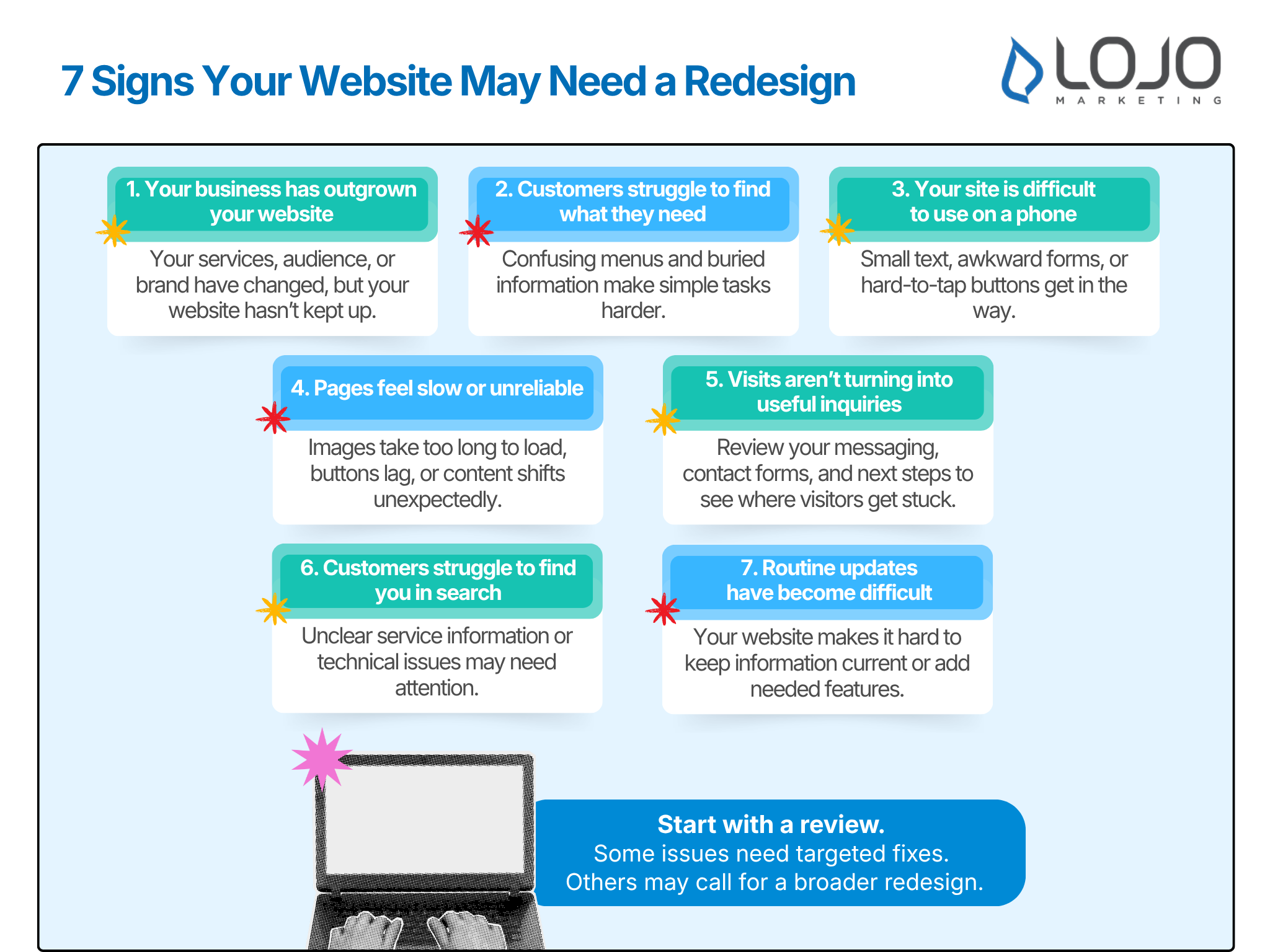
7 Signs It's Time for a Website Redesign
1. Your website no longer reflects your business
Businesses change. Your services, customers, service area, or approach may have evolved since your website was built.
Review whether the site still gives an accurate picture of:
✔️ The services you currently provide
✔️ The customers you are best equipped to help
✔️ The locations you serve
✔️ Your team, work, and brand
✔️ What customers can expect when they contact you
A few outdated photos or service descriptions may only require content updates. A broader redesign becomes worth considering when the entire site is organized around a business model or audience you have moved away from.
Visual presentation matters, too. Hard-to-read text, inconsistent layouts, and crowded pages deserve attention. But following a design trend is a weaker reason to rebuild than solving a specific customer problem.
2. Visitors have trouble finding or taking action
A website can look polished and still be frustrating to use.
Ask someone unfamiliar with your site to find a service, check your service area, and submit an inquiry. Watch where they hesitate. Avoid guiding them through it—the points of confusion are what you need to see.
Common problems include unclear menu labels, important details hidden several pages deep, and buttons that do not explain what happens next.
Also review basic usability: Is the text easy to read? Are form fields clearly labeled? Can someone navigate without a mouse?
If the same obstacles appear throughout the site, revisiting its structure and design may be more practical than correcting each page separately.
3. The mobile experience makes simple tasks difficult
Mobile phones accounted for 42.2% of U.S. web traffic in August 2026, according to Statcounter. While your website’s audience may differ, that share shows why the mobile experience deserves attention: customers need to be able to explore your services and contact you from their phones.
Open your website on a phone and complete the same tasks a customer would. Can you read the page without zooming? Open the menu? Tap the phone number? Complete the form without fields or buttons disappearing off-screen?
A responsive website adjusts its layout to different screen sizes. That is a useful foundation, but you still need to test whether the experience works in practice.
Pay particular attention to booking tools, pop-ups, chat windows, and contact forms. A page may fit the screen while an important task remains difficult to complete.
An isolated display issue may need a small repair. Problems across menus, page layouts, and forms can point to a broader design issue.

4. Pages feel slow or unreliable
Slow-loading images, delayed buttons, and content that shifts while someone is reading can make a website frustrating. Those problems can also affect whether visitors become customers.
In a 2021 case study published on Google’s web.dev, Vodafone tested two versions of a landing page. The version that loaded its largest visible content element 31% faster generated 8% more sales. That result is specific to Vodafone’s test, but it illustrates why website performance deserves attention alongside appearance.
Google’s Core Web Vitals measure aspects of loading speed, responsiveness, and visual stability. These measurements can help identify problems, although good scores do not guarantee strong search rankings.
Before deciding to rebuild, ask your website provider to investigate the cause. Large images, unnecessary scripts, third-party tools, or hosting issues may be repairable within the existing site.
A redesign may make sense when performance problems are widespread and tied to the site’s underlying structure. The recommendation should explain what is wrong and how the proposed work will address it.
5. Your website is not supporting meaningful inquiries
If your website receives visitors but produces few useful inquiries, investigate where the process breaks down.
Start with practical questions:
Are visitors arriving for services you actually offer?
Does the page match what the ad, email, or search result promised?
Is the next step clear and appropriate?
Do forms work, and do submissions reach the right person?
Are inquiries being tracked accurately?
Traffic totals and bounce rate can provide context, but they do not tell the whole story. In Google Analytics 4, bounce rate measures the percentage of sessions that were not engaged; it is not simply the percentage of people who viewed one page and left.
Review website activity alongside qualified calls, quote requests, bookings, or sales. Also check what happens after an inquiry arrives. A website redesign will have limited value if the main issue is missed messages or inconsistent follow-up.

6. Customers struggle to find you in search
Poor search visibility is a reason to investigate your website, but it does not automatically mean you need a redesign.
Search engine optimization, or SEO, helps search engines understand your content and helps people discover relevant pages. Google’s guidance includes clear page titles, useful content, descriptive links, and a site structure that makes pages accessible.
Review whether your website clearly explains your services using language customers understand. For a local business, that also means making your actual service area easy to identify.
AI-powered search does not create an automatic need to rebuild, either. Google says its established SEO practices remain relevant to AI Overviews and AI Mode, with no additional requirements or special optimizations needed to appear in those features.
“The best practices for SEO remain relevant for AI features in Google Search (such as AI Overviews and AI Mode). There are no additional requirements to appear in AI Overviews or AI Mode, nor other special optimizations necessary. That said, it's always good to review the fundamental SEO best practices.”
The useful question is whether your current website allows you to publish clear, helpful information and resolve technical problems. If it does, focused improvements may be enough. If its structure consistently prevents that work, a redesign may be justified.
7. Your website is difficult to maintain or expand
Your site should support the work your business needs to do.
Perhaps you want customers to book appointments, request estimates, browse products, or find answers before calling. Adding one feature may be straightforward. In other cases, the existing site makes every addition difficult to manage.
Review the tools already in place:
Do forms and booking tools work reliably?
Can your team update routine information?
Are you paying for features you no longer use?
Does someone clearly own maintenance and troubleshooting?
Can the platform support your next business requirement?
Include social links in this review. Keep them accurate and useful, but let them serve a clear purpose. Adding a social feed or sharing buttons, by itself, is not a reason to redesign a website.
Do You Need Targeted Updates or a Full Redesign?
The right scope depends on how widespread the problems are and what is causing them.
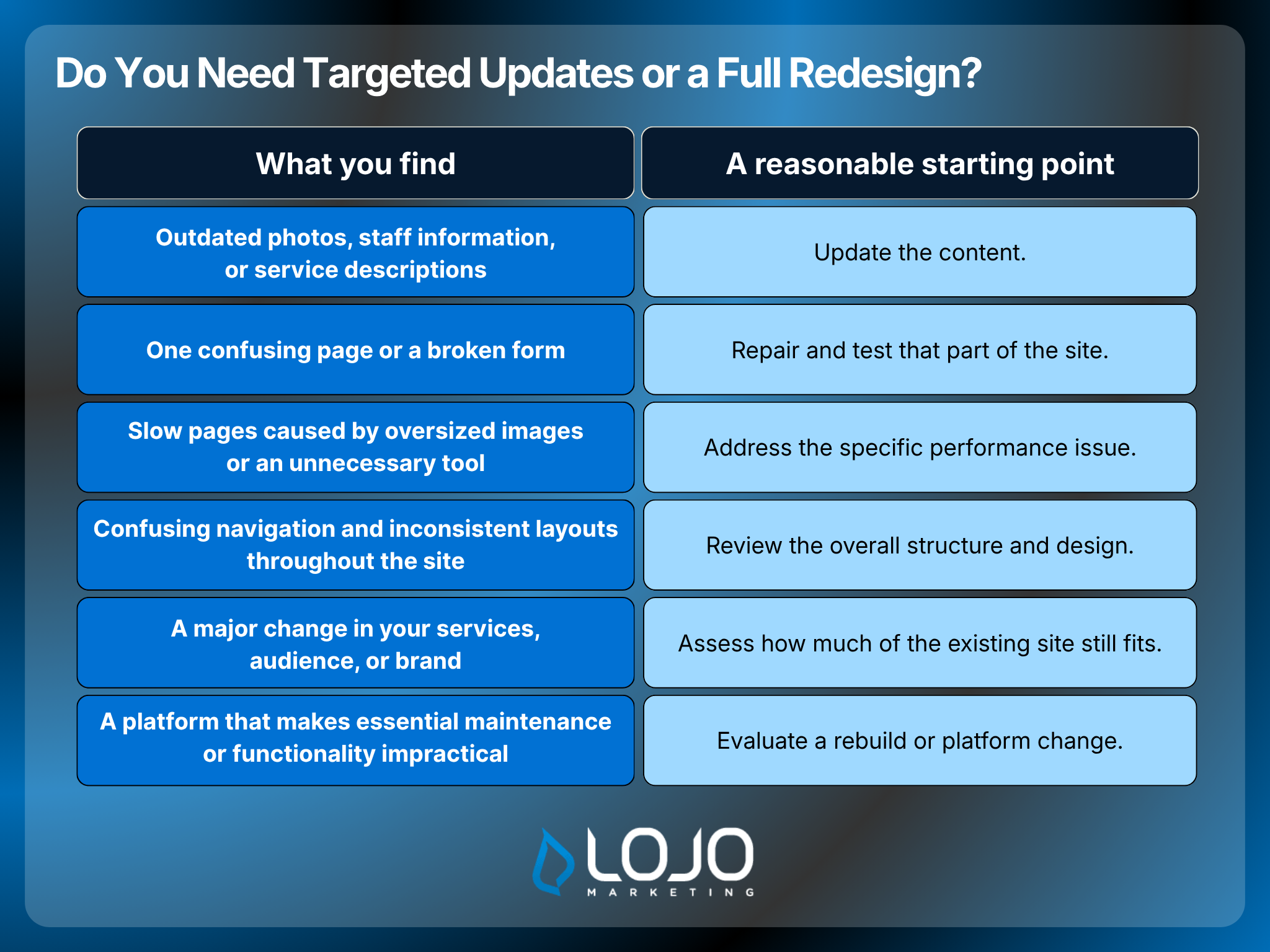
Ask your website provider to connect each recommendation to a problem you can understand. “The design feels dated” provides less direction than “customers cannot find the service they need, and the current navigation makes it difficult to fix.”
Competitor websites can offer useful context. Notice whether they answer customer questions more clearly or make common tasks easier. Use those observations to identify gaps in your own site without assuming you need the same features.

Plan a Redesign Around What Needs To Improve
If a redesign is the right next step, agree on its purpose before discussing layouts. Choose a small number of priorities, such as making service information easier to find, improving mobile inquiries, or simplifying updates for your team. Define how you will assess improvement after launch.
Also identify what should be preserved. Useful content, recognizable brand elements, and pages that already generate qualified inquiries should be part of the planning conversation.
Ask your web design team how it will handle:
Existing page addresses. When addresses change, permanent redirects should send visitors and search engines to the appropriate replacement pages. Google recommends permanent server-side redirects for permanent URL changes.
Forms and connected tools. Test submissions, notifications, booking steps, and other important functions before launch.
Measurement. Confirm that tracking captures the actions your business cares about.
Ongoing upkeep. Establish who will maintain the website and make future updates.
If you’re reviewing web design options, these questions can help make proposals easier to compare. A useful proposal should explain the problems being addressed, the work included, and what your team will need to provide.

Take One Practical Step Before Committing
Start with a short customer-focused review. Open your website on a phone, find your main service, and complete the contact process. Ask someone unfamiliar with the site to do the same.
Write down the three most important obstacles you find. Then ask your website provider which can be fixed within the current site and which may require broader changes.
LOJO Marketing can help you review those questions and determine an appropriate scope for website improvements. Having a clear picture of what needs attention makes it easier to choose a next step that fits your business, budget, and customers.
If you need help deciding where to start, contact our team to talk through what is working, what needs attention, and whether targeted updates or a redesign would better fit your business.

Built for Growth. Backed by 25 Years of Trust.
For over two decades, LOJO has been a trusted partner to hundreds of businesses just like yours. Whether working directly with owners, managers, teams, or boards of directors, our goal remains the same: to be a reliable and results-driven asset to your business.
Over the years, we’ve carefully built a team of experts—each selected for their unique skills, strengths, and personalities. Our clients choose LOJO because they know we genuinely care about their success.
And after 25 years of helping businesses grow, we’re more committed than ever.


Built for Growth. Backed by 25 Years of Trust.
For over two decades, LOJO has been a trusted partner to hundreds of businesses just like yours. Whether working directly with owners, managers, teams, or boards of directors, our goal remains the same: to be a reliable and results-driven asset to your business.
Over the years, we’ve carefully built a team of experts—each selected for their unique skills, strengths, and personalities. Our clients choose LOJO because they know we genuinely care about their success.
And after 25 years of helping businesses grow, we’re more committed than ever.



Matthew Rogers, President
iProspect Check
After spending several months reviewing multiple proposals from several different companies we engaged LOJO to develop a new website that represents our company effectively. We worked initially with Stephen Platte who helped create the scope of the project. Stephen was knowledgeable and always followed up with me on time and as promised.
He "closed the deal" for LOJO with his professionalism, service orientation and easy going approach. Once we signed the contract we were introduced to Jay Kelly who would be the creative lead for LOJO. This was the most challenging part of the project for my company, as there was no shortage of ideas from our side. Jay managed the project flawlessly, and once we had all agreed to the design, Jay introduced us to Eric.
Eric Lay is one of the founders of LOJO. Eric took the design we had developed and brought it to life. We delivered content as quickly as he requested it. Eric kept the project on task and we responded by exceeding every deadline for content. In turn, once provided, literally not a day went by that Eric didn't add the content and take the next step. In just a few weeks we launched our new website. Eric is a pleasure to work with.
His positive attitude and consultative approach really enhanced the experience and made a big difference for us in the outcome of our project. We would welcome you to visit our website to take a look at the quality work of LOJO. We are very pleased with LOJO and look forward to working with them in the future as we pursue an aggressive SEO strategy."
After spending several months reviewing multiple proposals from several different companies we engaged LOJO to develop a new website that represents our company effectively. We worked initially with Stephen Platte who helped create the scope of the project. Stephen was knowledgeable and always followed up with me on time and as promised.
He "closed the deal" for LOJO with his professionalism, service orientation and easy going approach. Once we signed the contract we were introduced to Jay Kelly who would be the creative lead for LOJO. This was the most challenging part of the project for my company, as there was no shortage of ideas from our side. Jay managed the project flawlessly, and once we had all agreed to the design, Jay introduced us to Eric.
Eric Lay is one of the founders of LOJO. Eric took the design we had developed and brought it to life. We delivered content as quickly as he requested it. Eric kept the project on task and we responded by exceeding every deadline for content. In turn, once provided, literally not a day went by that Eric didn't add the content and take the next step. In just a few weeks we launched our new website. Eric is a pleasure to work with.
His positive attitude and consultative approach really enhanced the experience and made a big difference for us in the outcome of our project. We would welcome you to visit our website to take a look at the quality work of LOJO. We are very pleased with LOJO and look forward to working with them in the future as we pursue an aggressive SEO strategy."
Matthew Rogers, President
iProspect Check
The team at LOJO were wonderful to work with. They are well organized and very patient as we worked through our marketing strategy and developed a well thought out and clear action plan at a reasonable price. We will definitely be back for our future campaign needs."

Jon Crosby, Founder
Dazil